
Summerween cakes run from 18-minute cupcakes to full-afternoon haunted houses, and the deciding factor is not skill but patience for structure.
A skull cake carved from frozen 9-inch rounds will hold its shape only if you dowel a witch shoe’s ankle joint, chill every layer before cutting, and let candy-coating walls set solid before adding a second story.
The 45–60 minute cakesicles demand that same temperature discipline; without it, the shell cracks and the red velvet center bleeds through.
1. Flower Cupcakes
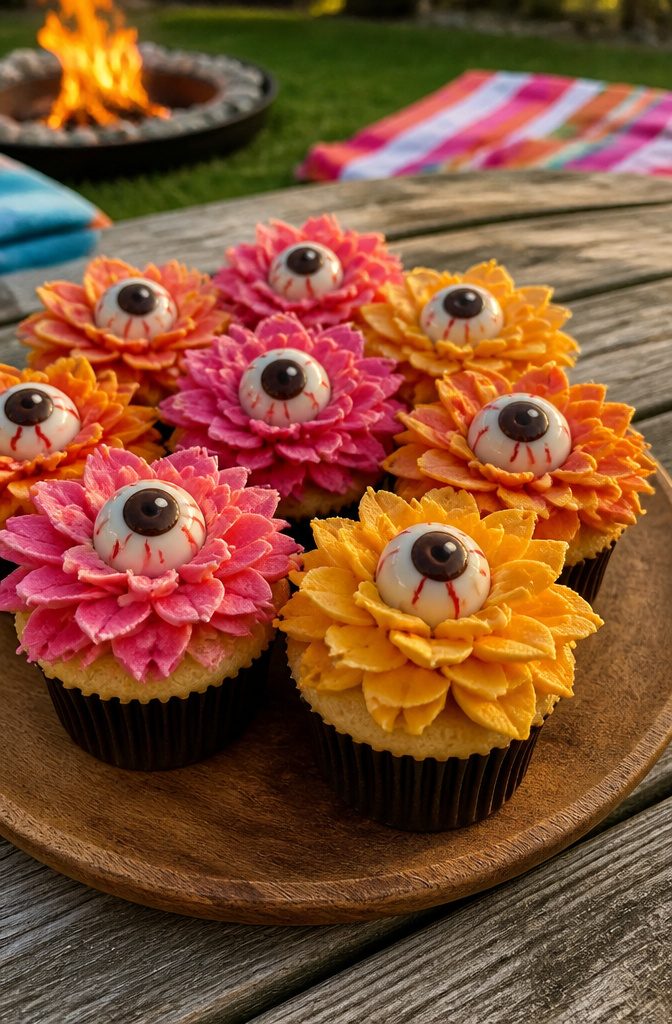
Flower cupcakes balance beach-party brightness with the unsettling edge that makes Halloween work. I build these on 500 g FunCakes Mix for Cupcakes, baked for 18–22 minutes, which gives a sturdy base that holds up to serious buttercream.
The decoration is where the two seasons collide: I pipe buttercream petals in saturated pinks, corals, and sun-yellows, then sink a chocolate eyeball into the center of each bloom.
The eyeball detail reads as spooky without abandoning the summer palette entirely, and the contrast between cheerful flower shapes and that blank, staring center is more disturbing than either element alone.
Because these are individual portions, they travel well and disappear fast at a party where guests are grazing between the pool and the fire pit. No slicing, no serving utensils, no one stuck at the cake table with a knife.
The two-tone petal technique works with a single decorating bag, though I find that step optional if you’re already juggling a dozen other Summerween prep tasks.
2. Red Velvet Cakesicles
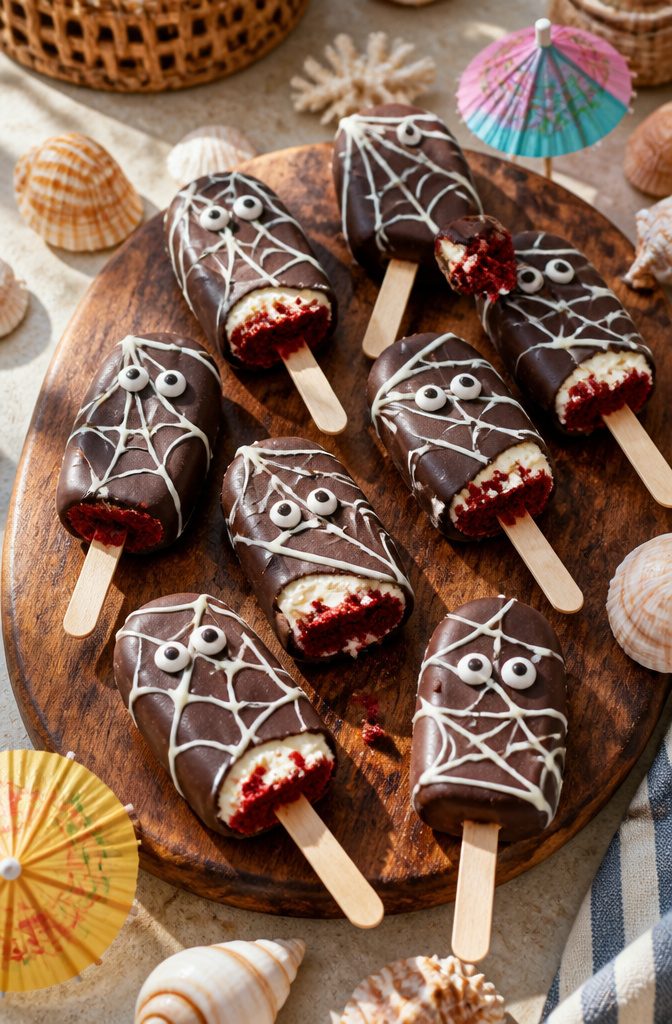
Red velvet cakesicles carry a 45–60 minute prep time and sit on the advanced end of the difficulty scale, which is where most home bakers should pause before committing.
The project is straightforward in concept: cake crumb mixed with cream cheese frosting, shaped into bars, then coated and decorated.
The shaping and coating are what drive the rating. A soft cake-and-frosting center has to hold its form through dipping and setting, and any crack in the shell exposes the filling underneath.
That sequence, repeated across a dozen or more pieces, asks for timing and temperature control that simpler cakes do not.
The summer angle is the popsicle silhouette, the Halloween angle is the decoration. Spiderweb drizzle, candy eyes, or a dark chocolate dip with orange swirl all read as haunted ice cream.
If coating and detailed finishing are still unfamiliar territory, a standard layer cake or even cupcakes will teach the same flavor combination with more room to recover from a misstep.
The cakesicles are rewarding, but they are not the place to learn tempering or handling melted coating for the first time.
3. Skull Cake with Raspberry Buttercream
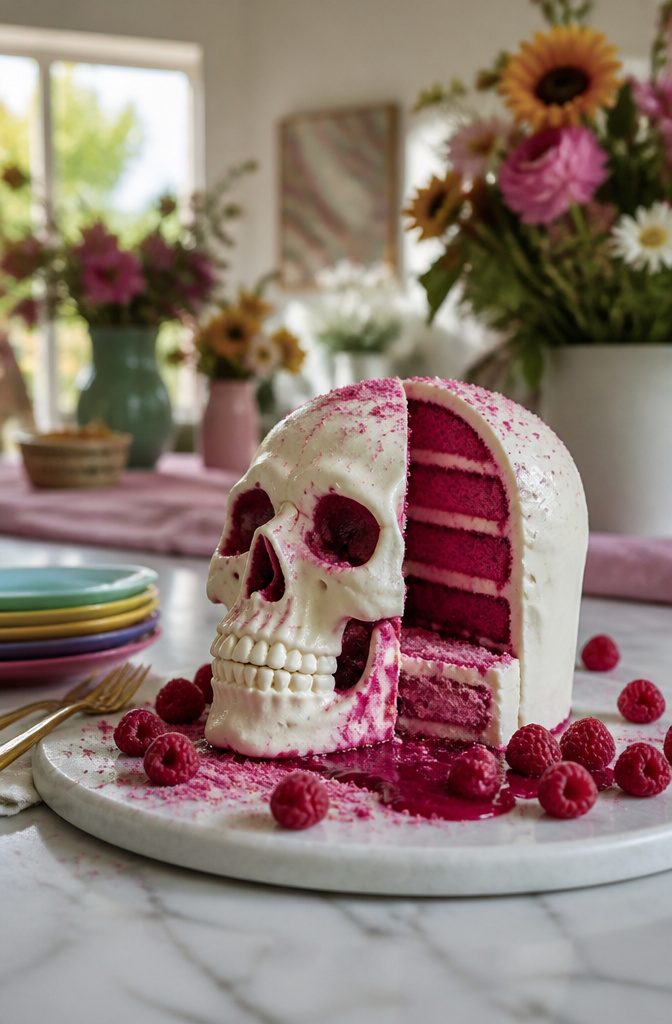
A skull-shaped cake reads as pure Halloween until you slice it and the raspberry buttercream stains the crumb a vivid, unexpected pink.
That color clash defines a summerween cake idea: the shape promises October, but the flavor pulls you back to July berry picking.
I build this one from two 9-inch rounds carved down with a small serrated knife rather than hunting a specialty pan.
The jaw and cheekbones need clean negative space to read from across the room, so I freeze the layers firm before cutting.
Cold cake flakes less, and you can shave the curves smooth with the flat of your blade instead of sawing.
The eye sockets and nasal cavity are the trickiest; I mark them lightly with a toothpick first, then remove just enough cake to suggest depth without turning the whole face into a cartoon.
Raspberry buttercream carries this better than vanilla because the tartness cuts through the sugar density of a shaped cake.
Vanilla would taste fine but reads as generic holiday dessert. The freeze-dried raspberry powder I fold in colors the frosting naturally and gives it a faint speckle that looks like aged bone under dim light.
Plan 90 to 120 minutes from mixer to final smoothing, most of it in those carving and chilling steps.
The buttercream crusts slightly as it sits, which is when I go back in with a damp paper towel to polish the skull’s high points.
4. Monster Bundt Cakes
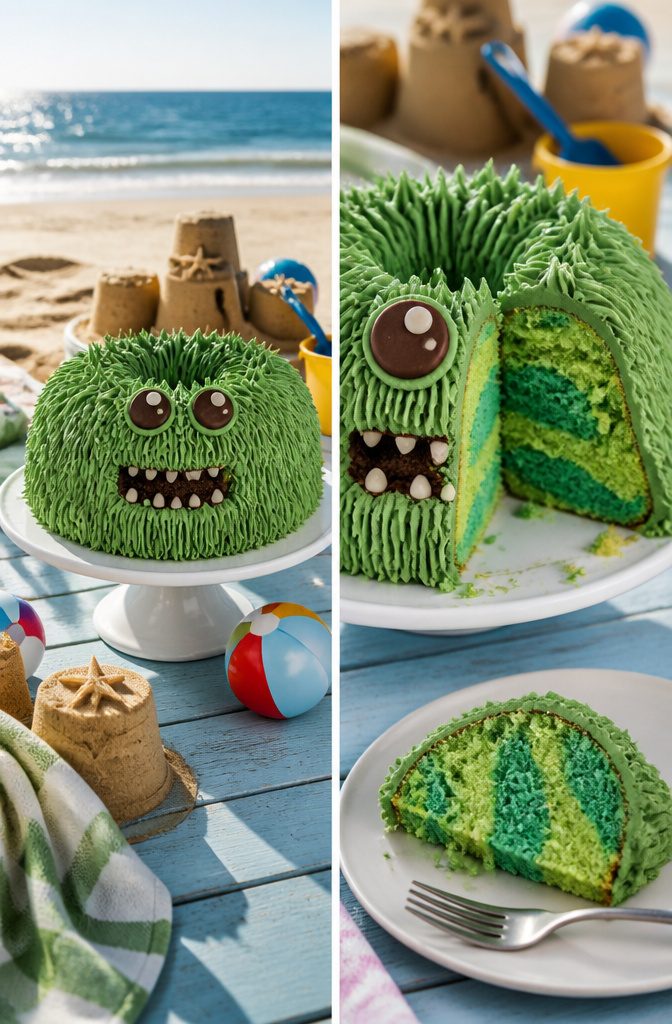
The ridged surface of a bundt cake already reads as fur or scales before you touch it, so decorating follows the geometry instead of fighting it.
A simple grass piping tip turns buttercream into shaggy monster fur with no sculpting skill required. Add two chocolate eyes and a candy mouth, and the cake becomes a funny creature rather than a decorated dessert.
A grass tip is standard grocery-store equipment, not a specialty purchase, which keeps this approach practical for a weeknight project.
The impact is high because the bundt’s own shape does half the visual work. For bakers who want a memorable centerpiece without carving or fondant, this is the option that delivers the most result for the least technique.
5. Witch Shoes Cake
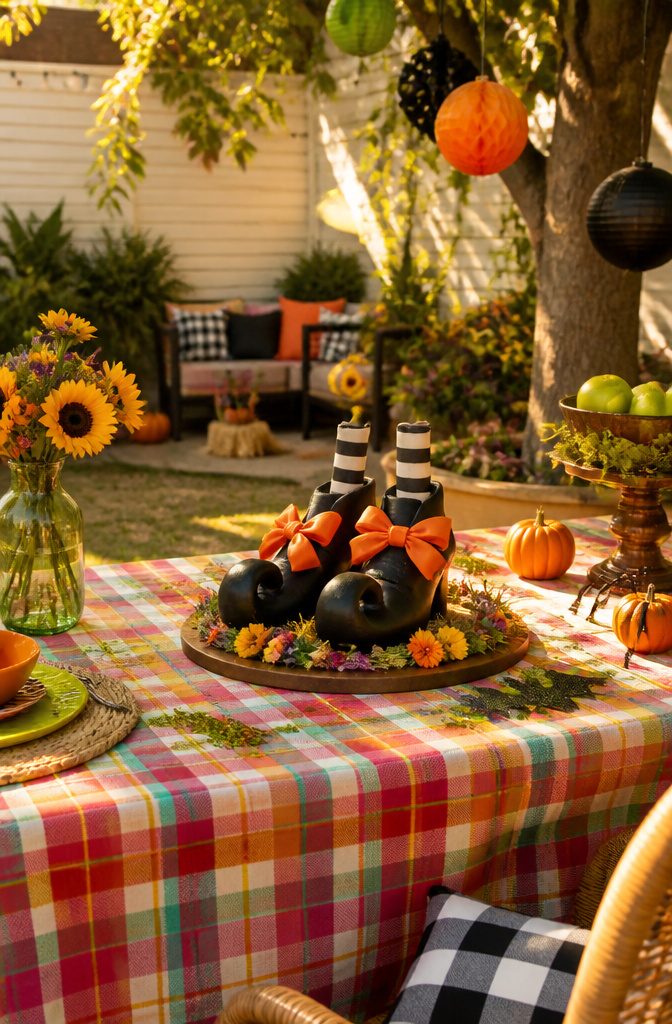
A pair of witch shoes with striped tights spilling from the top reads as pure circus-meets-coven energy, and the visual impact is immediate.
The bright stockings against black patent leather and a fat bow give you the Halloween anchor without surrendering summer’s color range. The bow and stripes are what sell the joke, so plan them first and build the cake around them.
Structure starts with two shoe shapes, which you can carve from stacked 9×13 sheet layers or bake in a shaped pan if you own one.
Each shoe needs a cake board at the sole and a center dowel running heel to toe, plus a second dowel where the ankle opening meets the cake board above.
Without that cross-bracing, the weight of buttercream ruffles and fondant bows drags the toe downward by hour three. I would rather over-support and trim a dowel flush than watch the arch collapse while guests arrive.
The tights are fondant strips in alternating colors, rolled thin and draped from the ankle opening down the back board. Keep the stripes horizontal at the top so the eye reads them as fabric falling, not ribbon glued on.
The bow sits at the outer ankle, oversized and slightly lopsided; symmetry here looks accidental, not whimsical. Cut the shoe itself in wedges from the heel end, working around that center dowel, and the slices hold shape without crumbling.
6. Ghost Cake with Balloons
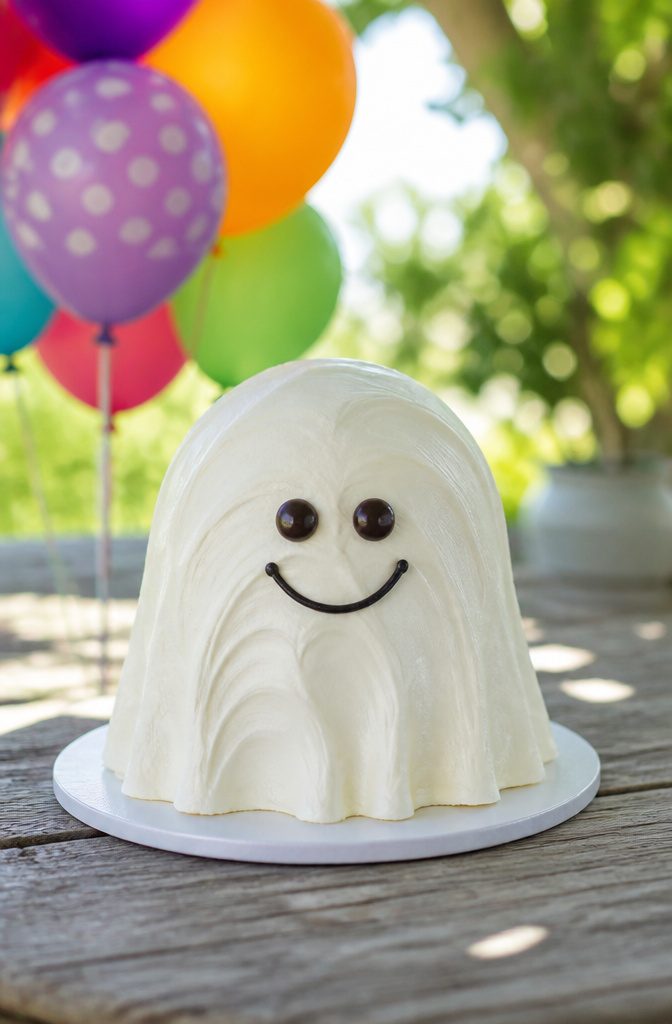
A rounded ghost cake in white buttercream reads softer than the sharp-edged haunted house cakes you see in October, which is exactly why it works for Summerween.
The shape is friendly, almost cloud-like, and the face can be as simple as two chocolate chip eyes and an oval of black frosting for a mouth.
The smooth white surface is the part that takes patience. Crumb coat first, chill until the buttercream firms up, then add a final layer and smooth it with a bench scraper dipped in hot water.
If the finish still shows texture, a light mist of white food coloring spray, applied in thin passes, will even it out without adding weight.
Balloons or fondant circles in bright summer colors, attached with skewers or wire, give the ghost dimension and lift the whole piece out of pure Halloween territory.
The sheet cake adaptation solves the serving problem shaped cakes always create. Bake a standard 9 by 13 inch cake, frost the top and sides white, and pipe the ghost shape onto the surface rather than carving it from stacked layers.
Portioning becomes clean squares instead of awkward wedges through a rounded form, and the decoration still delivers the idea.
7. Haunted House Cake
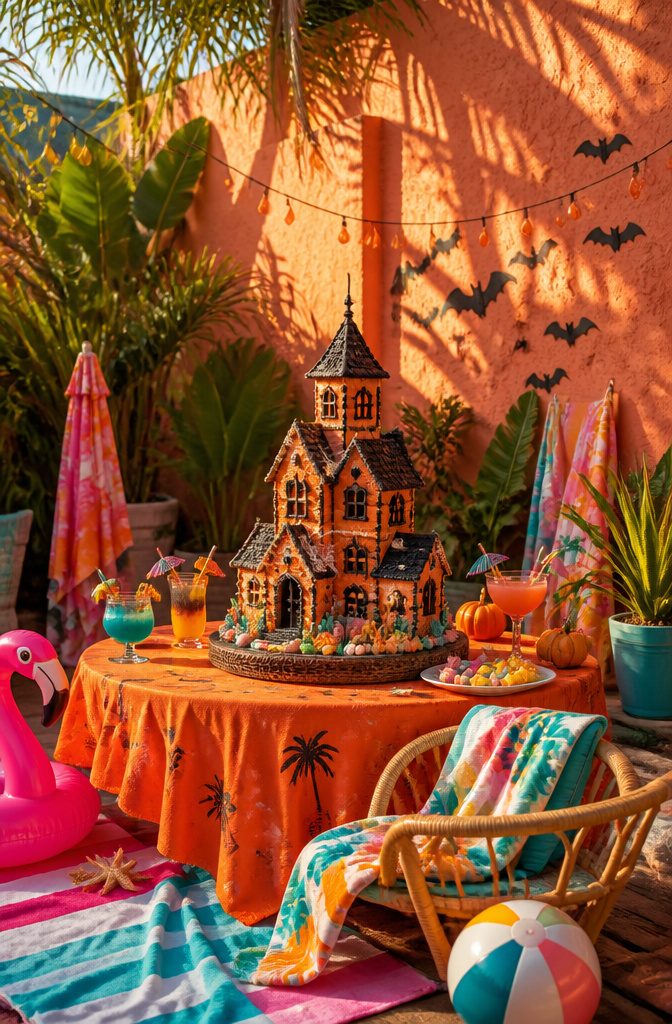
A haunted house cake built from buttercream walls and candy-coating accents reads Halloween first and loudest, so the summer half of Summerween needs deliberate help.
I would start with the architecture: graham crackers or chocolate wafer panels make the walls, and they can be spread with orange or hot-pink candy coating instead of the usual midnight black.
Those colors come straight from summer sunset palettes, and they keep the house from sliding fully into October.
For the details that sell the haunted part, candy eyeballs pressed into the buttercream mortar do more work than piped ghosts.
Stack them in clusters where a window should be, or line the roof peak so the house seems to watch the room.
Sugar ghosts and 3D wafer flowers layered around the base soften the spook with tropical notes, and they are light enough not to crush the structure.
Stability is the real fight here. Build the walls on a chilled cake, not a room-temperature one, and let the candy coating set fully before you add the second story.
The roof pieces can be made two days ahead and kept flat; once hardened, they handle like gingerbread. This is the most time-intensive cake on the list, and it earns its place only as a centerpiece.
If you do not have a full afternoon for assembly, the wafer flowers and pre-made candy decorations can be pressed into a simpler single-tier cake for the same mood in half the effort.
8. Pumpkin Spice Cake
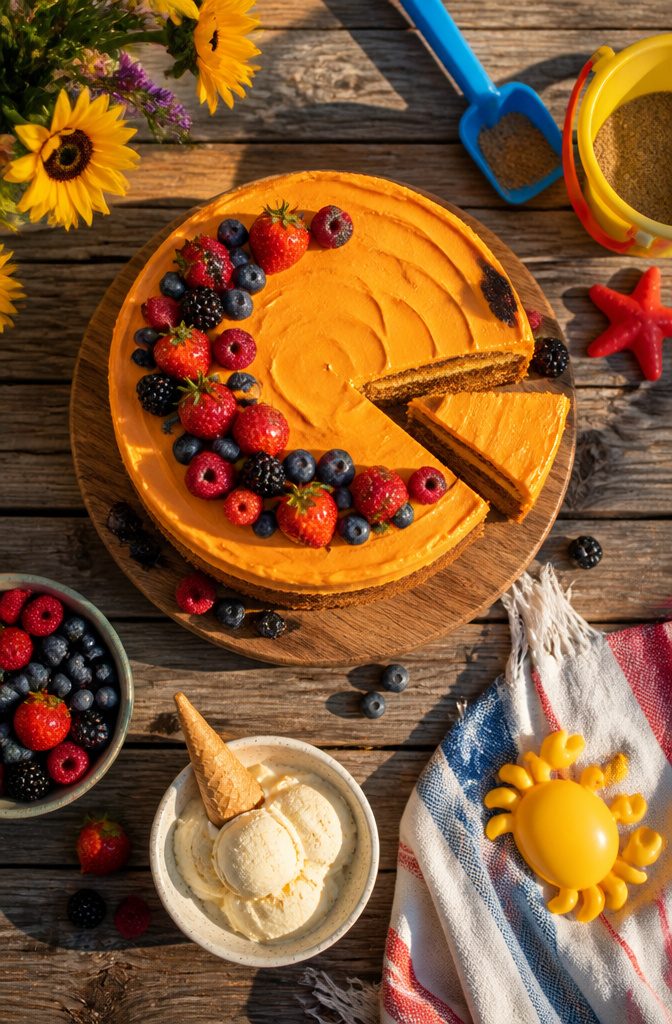
Pumpkin spice cake sits at the crossroads of late summer and early fall, which makes it the most reliable choice for anyone who wants Halloween flavor without Halloween decoration.
The warm spice blend reads autumnal rather than strictly spooky, so the cake leans on taste instead of skulls or orange frosting to earn its place at a Summerween gathering.
A few moves can pull it toward the beach side of the theme.
Orange cream cheese frosting adds brightness without changing the cake itself. Fresh berries on top, something you were going to buy anyway in August, give the plate color and a little acidity against the dense crumb.
Serving it with vanilla ice cream instead of buttercream keeps the dessert cold and casual, more boardwalk than harvest table.
This is the option for bakers who want a sure thing. The batter is forgiving, the layers stack flat, and the flavor already carries enough complexity that you can skip the novelty.
If you are decorating-averse, pumpkin spice cake is your safest bet among these ideas: the Halloween connection comes through cinnamon and clove, not through piping bags or fondant work you never wanted to learn.
9. Orange Velvet Cake
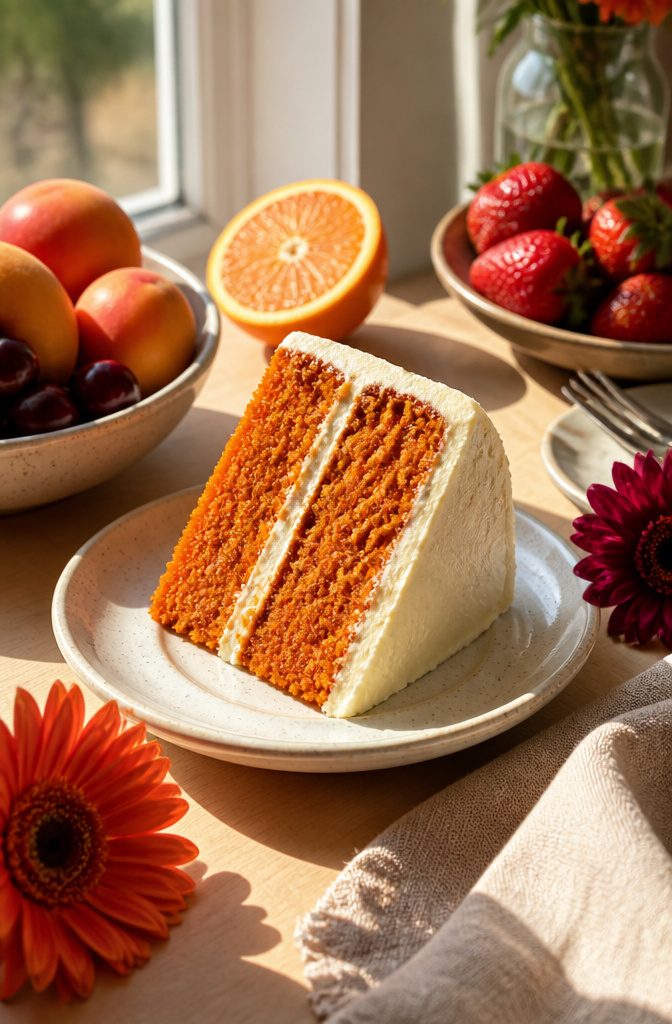
Velvet cake asks for oil instead of butter, and that single swap changes everything. The crumb turns finer and softer, almost plush against your tongue, because liquid fat coats flour proteins more evenly than solid fat ever could.
Buttermilk keeps the batter acidic, which weakens gluten and deepens that tender bite. The result sits denser on the plate than a standard butter cake but yields more easily under a fork.
Orange velvet makes the color work for a Summerween table without leaning on food coloring alone.
Carrot juice stains the batter a muted, earthy orange that reads autumnal in dim light and sunrise-bright in afternoon sun. Pumpkin puree does the same, and brings a faint vegetal sweetness that pairs well with cream cheese frosting.
Either route tastes of actual produce rather than laboratory red number 40, which matters when the party runs from grilled dinner into candlelit ghost stories.
I would build this in three layers, no taller.
The velvet structure needs width more than height to show off that tight, even crumb. Frost simply; the texture is the statement here, not the architecture.
10. Candy Bar Drip Cake
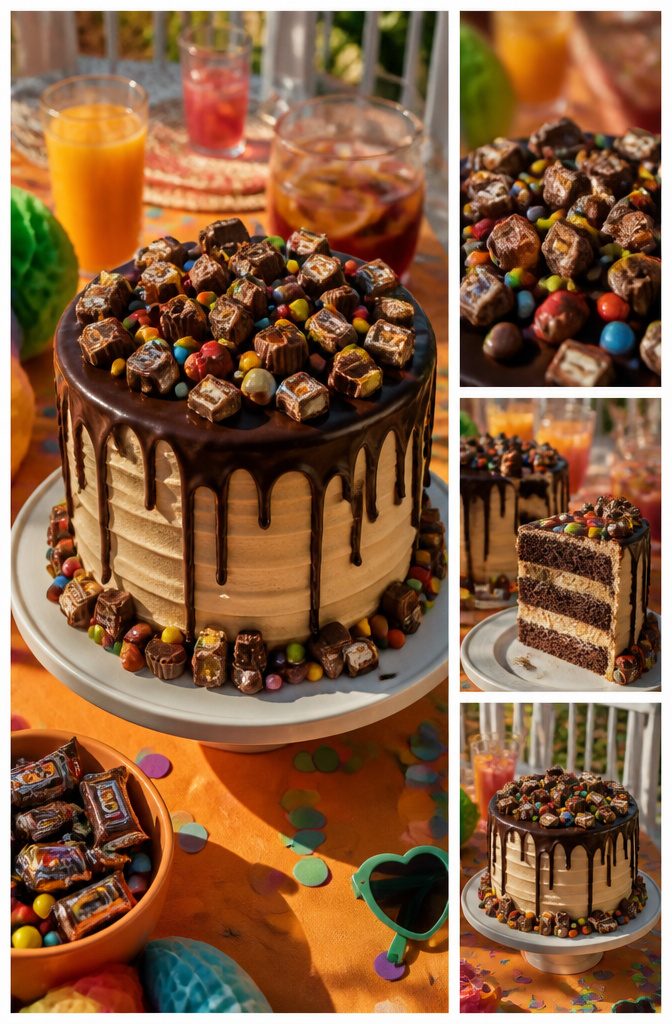
A chocolate ganache drip is the fastest way to make a home-baked cake look like it came from a bakery case, and for a Summerween party it carries the whole theme in one move.
Getting the ganache to flow just enough to drip down the sides without running straight to the plate takes practice; too warm and you lose the controlled drips, too cool and it sits on top like frosting.
I let mine sit until a spoonful holds its shape for a few seconds before I pour.
Once the drip sets, the candy does the decorating for you. I stick with wrapped miniatures, not loose gummy worms or anything that melts into the frosting.
Mini peanut butter cups, fun-size chocolate bars, and candy-coated chocolates hold up fine at room temperature for three or four hours, which covers most party timelines.
I attach them with dots of leftover ganache or buttercream while the drip is still slightly tacky, pressing each piece in for about two seconds so it bonds without sliding.
The result reads Halloween to anyone who grew up dumping their trick-or-treat haul on the living room floor, but the chocolate shell and beachy pastel wrappers you can find in summer seasonal mixes keep it from feeling like October in July.
What Summerween Means for Cake Flavors
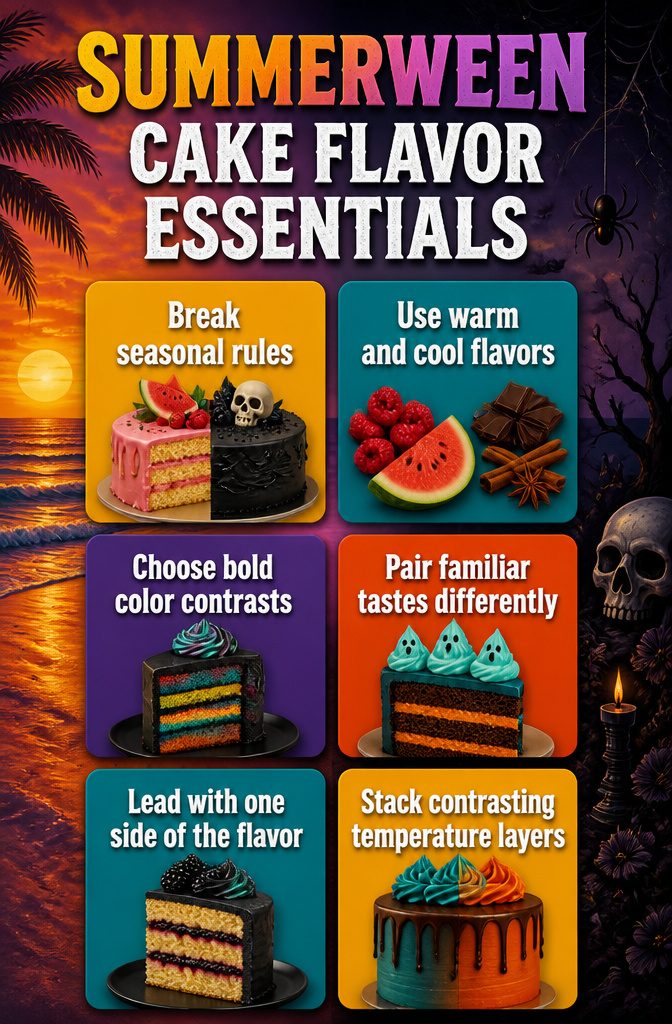
Summerween gives bakers permission to break the rule that pumpkin belongs to October and berries to July.
The holiday borrows Halloween’s visual language, skulls, spiders, midnight palettes, then sets the scene on a beach at dusk rather than a porch in late fall. That shift in setting changes what tastes right.
Warm autumn flavors like cinnamon, clove, and dark chocolate still read as haunted, but paired with cool summer fruit they stop feeling heavy.
Raspberry or watermelon against black cocoa buttercream creates the temperature clash the theme runs on: something you want to eat in August that still looks like it belongs to the witching hour.
I find the most successful summerween cakes pick one side to lead. A lemon cake with blackberry filling and charcoal-tinted frosting keeps the palate light while the color does the spooky work.
Reverse it for a chocolate pumpkin layer cake dressed in turquoise meringue ghosts, and the richness lands first, the beach vibe follows in the decoration.
Color temperature is the practical guide here.
Cool tones recede, warm ones advance. Stack them against each other in alternating layers or a gradient drip, and the cake looks active, like two seasons arguing in real time.
Blend them into murky middle territory, sage green or dull brown, and you lose the tension that makes summerween distinctive.
Grocery-Store Decorations That Read as Spooky
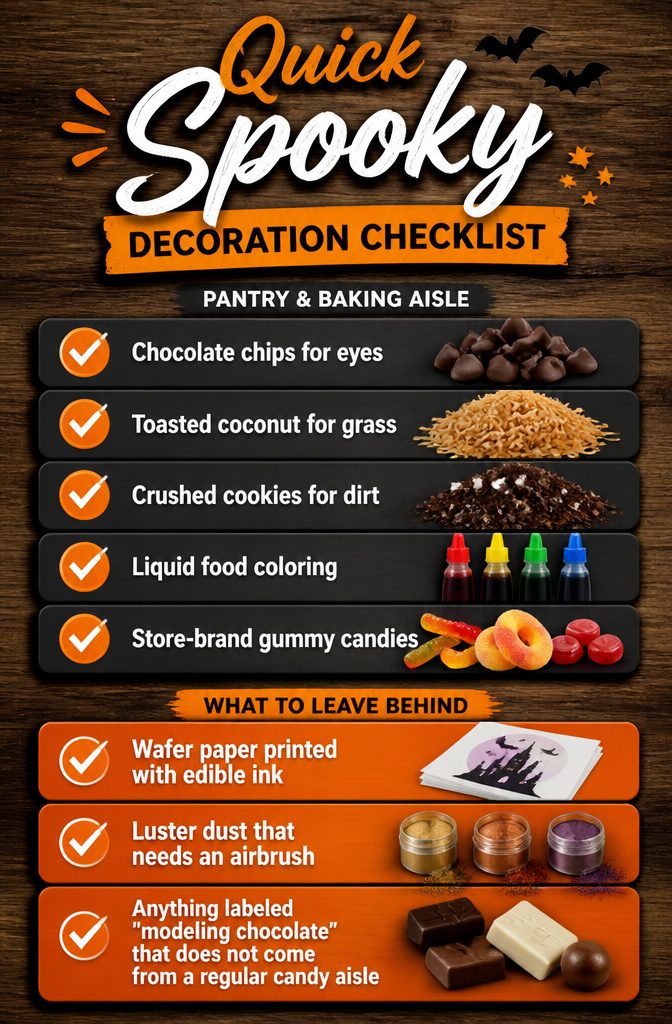
The decorations that read as spooky on a Summerween cake are almost all already in your pantry or one aisle over. Skip anything that needs a specialty supplier or a 48-hour shipping window.
- Chocolate chips pressed into fondant or buttercream make flat, glossy eyes that catch light the way candy eyes from a craft store do, at a fraction of the price and with no advance order.
- Shredded coconut toasted to straw color reads as dried beach grass; a few drops of green food coloring turn it into swamp turf that clings to frosting without piping skill.
- Crushed chocolate sandwich cookies, filling and all, pack down into convincing dirt once you press them with the back of a spoon. The filling binds the crumbs so they do not scatter across the cake board.
- Standard liquid food coloring from any grocery store works for tinting coconut or thinning buttercream into a wash. Gel is easier for deep blacks and saturated oranges, but the liquid bottle gets you close enough if that is what the store stocks.
- Store-brand gummy worms, sour peach rings, and hard cinnamon candies shape into tentacles, sunsets, or embers without a trip to a bulk candy site.
What to leave for someone else’s project: wafer paper printed with edible ink, luster dust that needs an airbrush, and anything labeled "modeling chocolate" that does not come from a regular candy aisle.
The effect on the finished cake is rarely worth the hunt.
Three Techniques That Carry Most of These Cakes
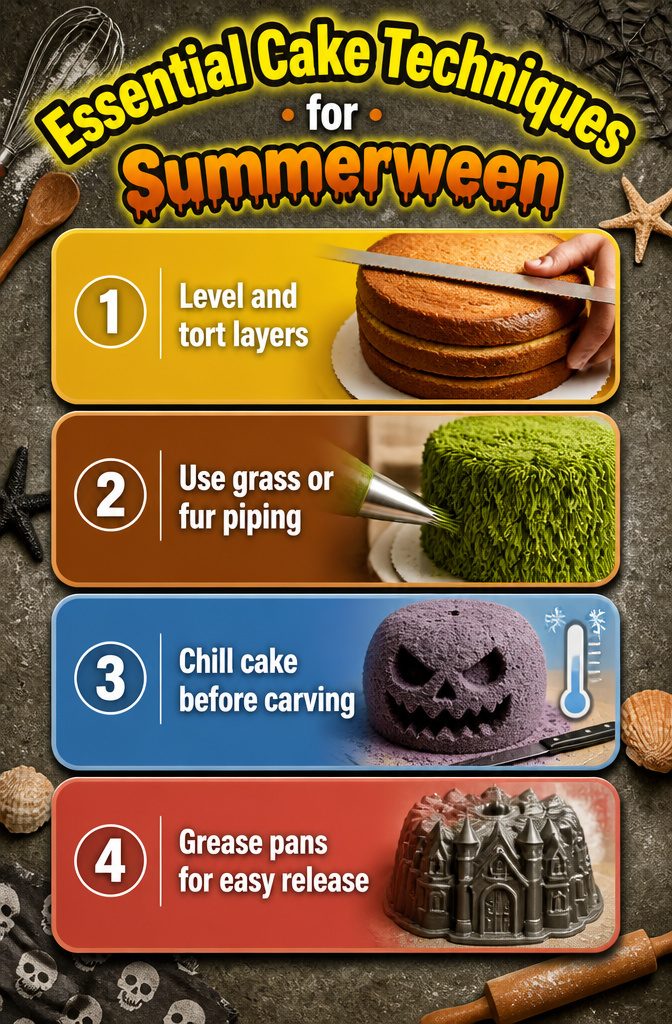
- Level and tort every layer once the cakes cool. A long serrated knife held flat against the domed top, or a cheap plastic leveler if you bake often enough, takes off the crown and splits each cake into two even sheets. Uneven layers slide; thin buttercream squishes out and the whole thing lists sideways by the time you add the third tier.
- A grass or fur piping tip does most of the texture work in these designs. The same #233 tip that reads as seaweed or sand grass on a beach cake becomes monster fur or wild moss on a haunted version. Load the bag, hold it straight down, squeeze and pull up: the ragged strands do the detail work so you do not have to pipe individual shapes.
- For shaped pans or freehand carving, chill the cooled cake until the crumb firms up, almost to a poundcake texture. A cold cake carves cleanly with a sharp knife; room temperature crumbles under pressure. If you are using a molded pan, grease every crevice with shortening, then dust with flour and tap out the excess. The cake releases in one piece, and the details stay sharp enough to highlight later.
Frequently Asked Questions
What are some Summerween cake ideas?
Flower Cupcakes with chocolate eyeball centers, Red Velvet Cakesicles in popsicle form, a Skull Cake with vivid pink raspberry buttercream, Monster Bundt Cakes with buttercream fur, Witch Shoes Cake with striped fondant tights, Ghost Cake with bright balloon accents, Haunted House Cake in sunset colors, Pumpkin Spice Cake with summer berries, Orange Velvet Cake, and Candy Bar Drip Cake with ganache and mini candy bars.
Each one pairs Halloween visuals with summer flavors or colors.
How do I make a Flower Cupcake?
Bake 500 g FunCakes Mix for Cupcakes for 18–22 minutes, then pipe buttercream petals in saturated pinks, corals, and sun-yellows.
Sink a chocolate eyeball into the center of each bloom for the Summerween twist. The two-tone petal technique works with a single decorating bag, though you can skip it if prep time is tight.
What is Summerween?
Summerween is a trend that blends Halloween vibes with summer fun, originating in the United States and gaining popularity through the animated series Gravity Falls.
For bakers, it means pairing autumn flavors like cinnamon and dark chocolate with summer fruits and bright colors, or setting spooky shapes against beachy palettes.