
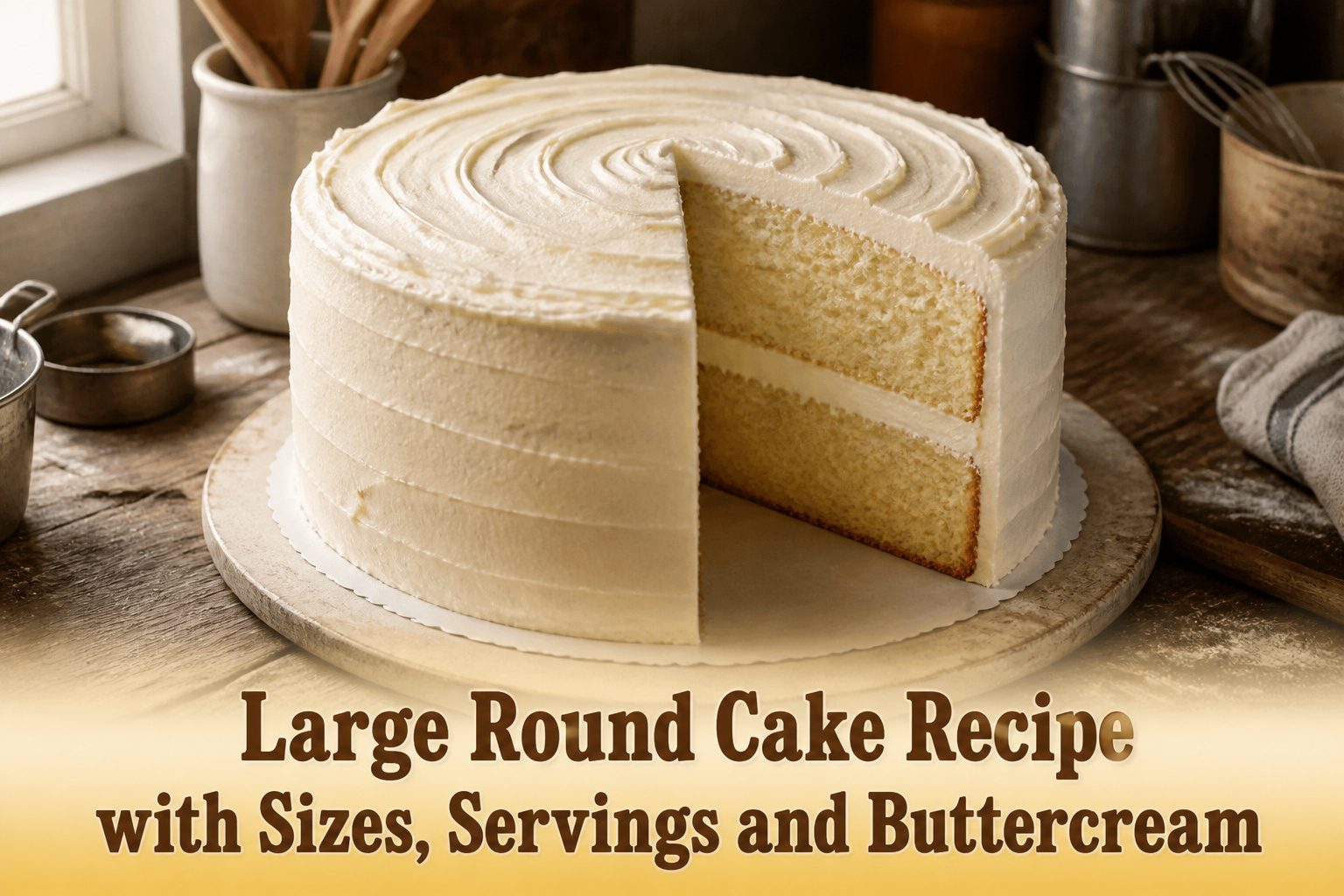
A 10-inch vanilla layer cake with a tight, even crumb and enough height for real celebration.
The difference from a standard round is the leavening: five teaspoons of baking powder, no more and no less, or the center domes and cracks under its own weight.
That precision, plus two layers baked separately rather than split, is what keeps a cake this size from collapsing into the dense, dry rounds most home bakers produce.
Cost is the problem. A bakery charges $150–$200 for this tier; bake it yourself and the markup disappears, though you will need a heating core or flower nail once the pan passes 10 inches.
The center sets last, and raw batter in the middle ruins the slice.
Ingredients

A 10-inch round vanilla cake that serves 28 to 38 at party slices scales up the proportions you already know, but the leavening needs a careful hand.
Too much baking powder and the center domes and cracks; too little and the crumb turns dense under its own weight.
I build this as two layers, each baked in its own 10 by 2-inch round pan. Splitting a single deep layer is unreliable at this volume, and the exterior dries before the center sets.
For the batter, you’ll need:
- 5 cups all-purpose flour, spooned and leveled
- 3 cups granulated sugar
- 2½ cups unsalted butter, softened but still cool
- 10 large eggs, room temperature
- 1½ cups whole milk
- 5 teaspoons baking powder
- 4 teaspoons pure vanilla extract
- 2 teaspoons fine sea salt
The butter temperature matters more than the exact minutes on the clock.
It should bend without cracking, not slump. Cold butter traps air poorly; warm butter creams too soft and the layers sink in the center.
Make the Cake
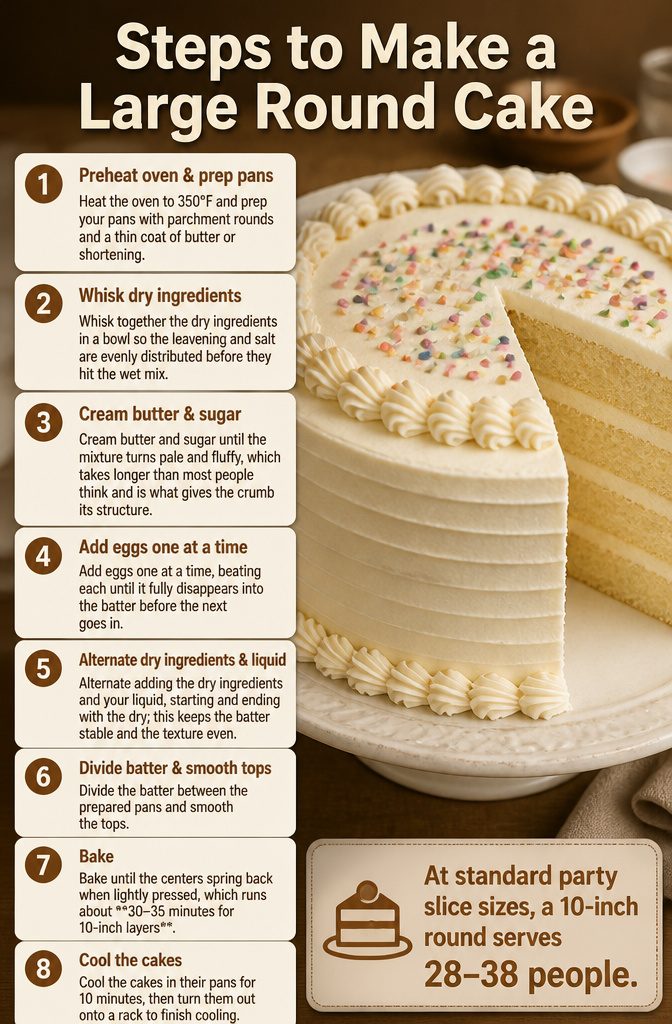
- Heat the oven to 350°F and prep your pans with parchment rounds and a thin coat of butter or shortening.
- Whisk together the dry ingredients in a bowl so the leavening and salt are evenly distributed before they hit the wet mix.
- Cream butter and sugar until the mixture turns pale and fluffy, which takes longer than most people think and is what gives the crumb its structure.
- Add eggs one at a time, beating each until it fully disappears into the batter before the next goes in.
- Alternate adding the dry ingredients and your liquid, starting and ending with the dry; this keeps the batter stable and the texture even.
- Divide the batter between the prepared pans and smooth the tops.
- Bake until the centers spring back when lightly pressed, which runs about 30–35 minutes for 10-inch layers.
- Cool the cakes in their pans for 10 minutes, then turn them out onto a rack to finish cooling.
At standard party slice sizes, a 10-inch round serves 28–38 people.
Round Cake Sizes and Servings

A standard party slice measures 1 inch wide by 2 inches deep by the full height of the cake, usually 3 to 4 inches for a layer cake.
Wedding slices run smaller at 1 by 2 by 4 inches tall, which is why the same cake serves more guests at a reception than at a birthday party. The cutting convention matters more than the pan size.
| Pan Size | Party Servings | Wedding Servings | Typical Occasion |
|---|---|---|---|
| 4-inch | 6–8 | 8–10 | Smash cake, small gift |
| 6-inch | 10–14 | n/a | Intimate celebration |
| 8-inch | 14–24 | n/a | Family dinner |
| 10-inch | 28–38 | 35–45 | Birthday party of 25–35 guests |
| 12-inch | 40–50 | 50–60 | Party of 35–45, small office |
| 14-inch | 55–65 | 65–80 | Large party of 50+, main tier |
| 16-inch | 72–85 | 85–100 | Very large party, wedding base tier |
I keep Wilton’s party sizing in mind too, which calls slices slightly larger at 1½ by 2 inches.
That drops the count a bit, so I treat the table above as the generous end of the range and Wilton’s as the conservative one.
For a mixed crowd of kids and adults, the larger slice is the safer bet; for a reception where guests just want a taste of dessert with their coffee, the wedding count holds fine.
Tiered Cake Servings
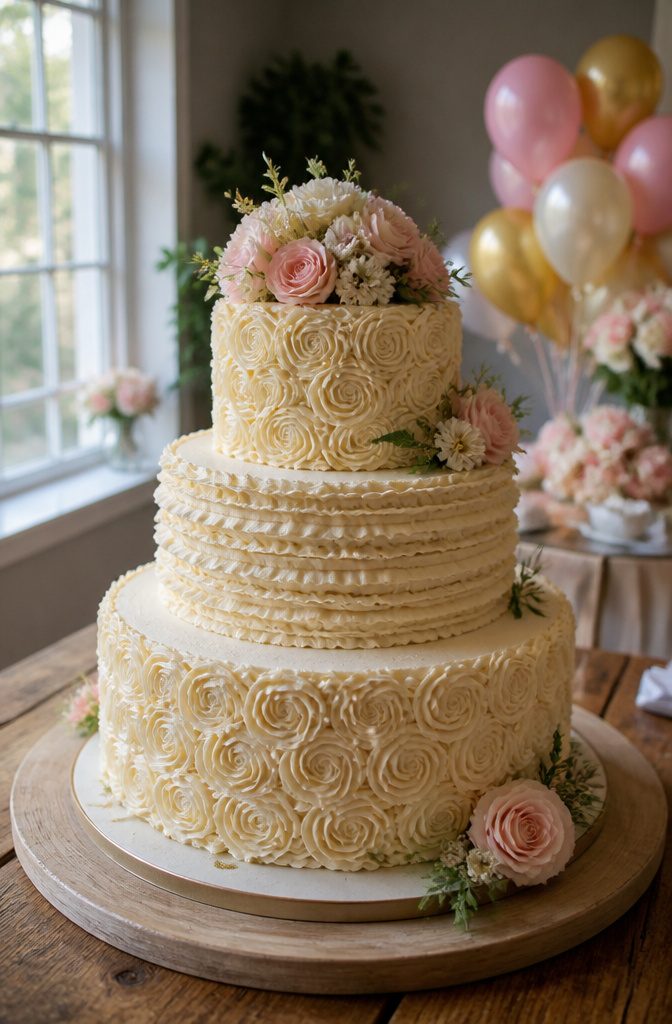
Tiers make sense once a single round cake stops being practical, not just because the numbers get big.
A 12-inch layer serves 40–50 party portions, which already covers most birthdays. Stacking tiers is about height and presentation; the serving count is almost a side effect.
Combinations break down like this:
- 2-tier 6 + 8 inch: 28–38 servings. This barely exceeds an 8-inch single tier’s 28–38 range, so I only build this when the couple inches of extra height matters for the look, or when someone wants two different flavors by tier. For straight headcount, one 10-inch layer at 28–38 servings is simpler.
- 3-tier 8 + 10 + 12 inch: 68–88 servings. This is the threshold where tiers become genuinely necessary for guest count. It covers the 50–60 of a single 12-inch and the 72–85 of a 16-inch, so you are buying the stacked shape, not just the servings. I use this for events where the cake needs to read as the centerpiece.
- 3-tier 10 + 12 + 14 inch: 85–105 servings. The step up is modest against the extra cake and structure involved. I only recommend this when the room or the table demands physical presence, or when a couple specifically wants generous party portions rather than wedding-thin slices. Otherwise the 8-10-12 combination usually covers the same crowd.
Common Sizing Mistakes
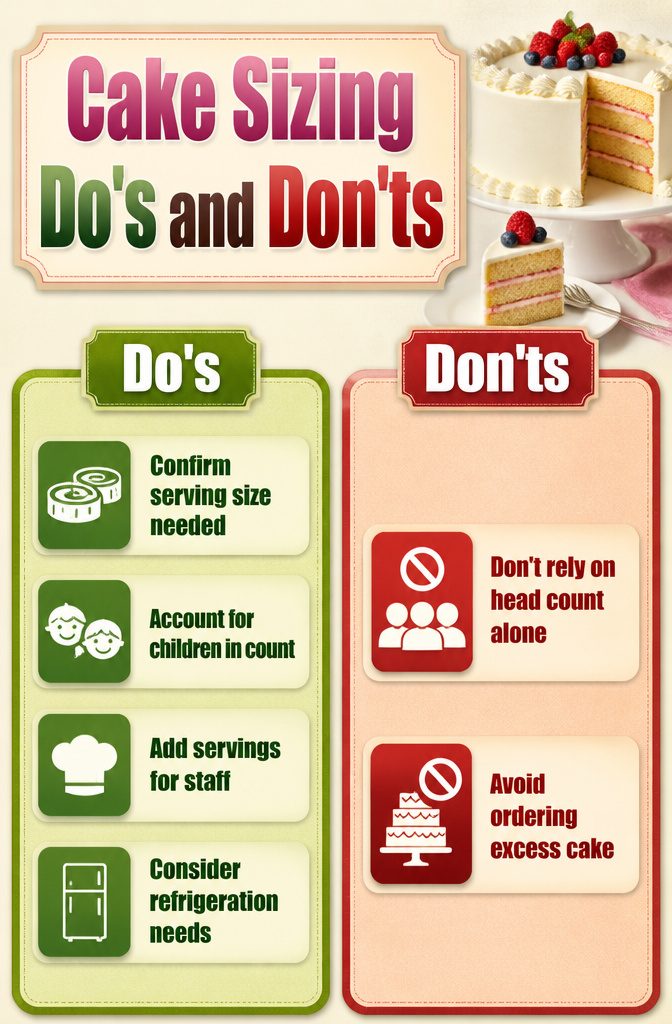
The biggest mistake I see with a large round cake is ordering by head count alone without confirming what "a serving" actually means.
A party slice runs about 1.5 by 2 inches, while a wedding slice is closer to 1 by 2 by 4 inches tall. That difference turns the same cake into two very different counts.
Children are easy to forget and hard to count. Most kids eat half to two-thirds of an adult portion, so a group of 20 adults and 10 children eats closer to 25 adult servings, not 30.
Staff and vendors need a line item too. Caterers, venue crew, and the baker will expect cake; add four to six extra servings or ask that staff portions come from a separate kitchen cake.
Leftovers are not the disaster people imagine.
A cake ordered "just to be safe" for 100 guests at a party of 60 produces serious storage pressure. Cut cake needs refrigeration within two to four hours, and quality drops after two days.
The better move is confirming slice size with whoever is cutting, because serving charts are estimates. The person holding the knife decides what 1 inch actually looks like.
What a Large Round Cake Costs

An 8-inch round from a quality bakery starts at $120–$155, and a 10-inch jumps to $150–$200. Those are baseline custom prices, not ceiling prices, and home baking costs a fraction of that once you already own the pans.
Round cakes do cost more per serving than sheet cakes for the same head count.
A quarter sheet, 9×13 inches, serves the same 24 guests a 10-inch round serves, yet the sheet runs $22–$45 at a grocery store bakery while the round lands in that $120–$200 range.
The gap pays for structural complexity, layered assembly, and finishing work on a curved surface.
That extra cost is the trade-off for the presentation. A round layer cake sits taller, cuts cleaner for plated dessert, and gives you vertical space for decoration that a sheet simply does not have.
For weeknight family dinner the sheet cake wins on value. For a birthday where someone will photograph the candle blow, the round earns its markup.
Buttercream for a Large Cake

Buttercream for a large round cake scales with surface area, not servings, which is the detail that trips most people up.
A 10-inch two-layer round needs roughly 6 cups for a thin coat and 8 cups for fuller coverage and simple decoration. That two-cup gap matters because the sides of a wider cake grow faster than the top does.
Lateral area on a 12-inch round is nearly half again what it is on a 10-inch, so jumping up in diameter demands more frosting than jumping up in height.
The crumb coat and final coat are separate applications.
I figure 2 to 2½ cups for the thin layer that seals the crumbs, then the rest for the smooth finish and any piping. Wilton charts a 10-inch round at 4½ cups to "ice and decorate," but that assumes a modest finish:
A 10 in. round at 3 in. high takes 4½ cups of icing to ice and decorate.
— Wilton
That figure runs light for anything beyond a basic border.
I add a third again for rosettes, ruffles, or writing, and I always mix extra rather than risk a color match mid-project. Leftover buttercream keeps for two weeks in the refrigerator.
Baking Tall and Large Layers

Batter spreads outward faster than it sets when a pan passes 10 inches, which leaves the center raw while the rim is already dry.
The fix is a heating core or flower nail set dead center, metal conductors that draw oven heat straight to the middle. Wilton recommends one core for any round 12 inches or wider at 3 inches deep, two for an 18-inch half-round.
I use them for anything over 10 inches or whenever a layer runs taller than 2 inches, since height slows heat penetration the same way width does.
Time climbs with diameter, not dramatically but predictably: roughly 5–10 extra minutes per added inch at 350°F. A 10-inch round takes 55–60 minutes, while a 12-inch needs 70–75. I never level warm layers.
The crumb stays steam-soft for an hour or more out of the oven, and a knife dragged through it tears rather than slices. Fully cooled cake is firm enough to trim flat without complaint.
Frequently Asked Questions
What is a standard cake serving size?
A standard party slice is 1 inch wide by 2 inches deep by the full height of the cake, usually 3 to 4 inches for a layer cake.
Wedding slices run smaller at 1 by 2 by 4 inches tall, which is why the same cake serves more guests at a reception than at a birthday party. Cutting convention matters more than pan size.
What size cake do I need to feed 20 people?
An 8-inch round layer cake serves 14 to 24 people at party slice sizes, so it covers 20 guests comfortably. A 10-inch round serves 28 to 38 and gives you breathing room if portions run large or a few extra people show up.
Is a 6-inch cake enough for 4 people?
Yes, a 6-inch round layer cake produces 10 to 14 standard party slices, which means 2.5 to 3 slices per person for a group of 4. That leaves generous portions plus seconds for anyone who wants them.
How many tiers do I need for a wedding of 100 guests?
A 3-tier cake in an 8-inch, 10-inch, and 12-inch configuration produces 68 to 88 party servings, which falls slightly short of 100.
For a full 100 at party portions, step up to a 10-inch, 12-inch, and 14-inch combination at 85 to 105 servings, or plan on wedding-thin slices from the smaller tier set.
What size round cake will feed 25 people?
A 10-inch round layer cake serves 28 to 38 at party slice sizes and is the most common order for a group of 25 to 35 guests. An 8-inch round tops out at 24 party servings, which risks running short.
What is the largest round cake pan size?
For anything wider than 10 inches or taller than 2 inches, use a heating core or flower nail to draw oven heat to the center so the middle sets before the rim dries out.
What are large cakes called?
Large single cakes are simply called large round cakes or by their diameter, like a 14-inch round.
Once a single round stops being practical, bakers stack tiers, combinations like 8-inch plus 10-inch plus 12-inch, to add height and presence without baking one impossibly wide layer.
Can a 10-inch round cake feed 20 people?
Yes, easily.
A 10-inch round layer cake serves 28 to 38 people at standard party slice sizes, so 20 guests leaves you with generous portions and leftovers. It is sized for birthday parties of 25 to 35 guests, making it the most common large round cake order.