
The right 18th birthday cake depends on whether you are buying or building it, and how many hours you are willing to spend on structure.
A tilted tier demands internal pillars drilled plumb through crooked layers, while a buttercream marble hides knife marks and skips the hardware entirely.
The one detail that separates edible gold leaf from craft gold leaf is a food-grade label; without it, you are brushing copper and aluminum onto frosting.
1. Pink Ombre Cake with Rose

Soft shades of pink and cream give this cake its romantic ombré look, achieved by tinting buttercream in graduated tones and applying them in horizontal bands that fade from deep rose at the base to pale blush at the top.
The technique is forgiving: you build the color in three or four stages, blending the edges where each tone meets so the shift reads as continuous rather than striped.
A single large pink rose, piped by hand or set as a topper, anchors the design as the focal point instead of scattering smaller flowers across the surface.
That restraint keeps the cake feminine without tipping into the juvenile territory of all-over sprinkles or too many pastels.
For an 18th birthday, the balance lands right: celebratory and grown-up enough for someone crossing into adulthood. Gold glitter on the topper or base board adds the final touch of elegance that the milestone calls for.
2. Monochrome Marble Cake

A monochrome marble finish reads as deliberate without demanding you commit to one color.
Black, white, and gray buttercream or fondant get swirled together so the tones bleed into each other at the edges, and that is exactly what you want: the design looks controlled precisely because it is not controlled.
You are not trying to match a Pantone or finding out that your "blush" reads as peach under kitchen lights. The palette already accounts for variation.
Buttercream marble is more forgiving than fondant for a home kitchen, since the swirl hides the small knife marks and temperature cracks that would ruin a solid-color finish.
Work with three bowls of tinted buttercream, not two: a true black, a bright white, and a middle gray.
Two colors read as accidental; three read as designed. Drop alternating spoonfuls around the cake, then smooth once with an offset spatula so the colors marble but do not muddy.
Fondant gives sharper edges and a glossier surface, though it costs more time and a smoother base coat underneath.
For an 18th birthday, buttercream marble lands in the right spot: sophisticated enough for the milestone, relaxed enough that the birthday person does not look overstyled.
3. Black and Gold Luxe Cake

A deep black fondant base reads as instant luxury on an 18th birthday cake, and the gold is what signals celebration rather than gloom. You have two ways in.
Luster dust mixed with lemon extract or vodka gives you a brush-on metallic paint that catches light across fondant ridges and moldings. It is forgiving, layerable, and the bottle costs a fraction of what the other route runs.
Gold leaf, pressed onto tacky fondant with a soft brush, delivers the real thing: mirror-bright, utterly flat, no brush marks. It is also brittle, shows every fingerprint, and a single sheet costs what a jar of dust does.
Here is the limit that matters.
In the United States, edible gold leaf must carry a food-grade rating. Decorative gold leaf, the kind sold for crafting and gilding furniture, sits right beside it online and sometimes in the same shop.
The decorative stuff is not held to the same purity standard and may carry copper or aluminum you do not want on cake.
Check the label for a food-grade or edible claim before you buy. If the packaging only says "decorative" or "craft," it belongs on a frame, not a birthday cake.
4. Bumblebee-Themed Cake

Yellow and black stripes read instantly as a bumblebee, which makes this 18th birthday cake a natural fit for spring and summer parties when the flowers are actually out and bees are something you see rather than just read about.
The fondant or candy bees on top take maybe 20 minutes to place if you buy them, an hour or two if you mold them from fondant with a small oval cutter and a toothpick for stripes.
Someone with a bee nickname, a family hive, or even a sorority connection to Delta Phi Epsilon gets a cake that feels personal without requiring custom figurines or airbrushing.
The stripped-back version skips the outside decoration entirely and relies on alternating yellow and chocolate cake layers that show the stripe only when you cut.
That approach saves hours of exterior smoothing and still delivers the moment of surprise. I would go with bought candy bees either way; the fondant ones look cute for about ten minutes in humidity before they soften and droop.
5. Cherry Red Vintage Cake

Deep red buttercream reads as celebration in a way softer pinks do not, and for an 18th birthday that shift matters.
The vintage 1950s-60s American bakery look comes from three specific piping techniques: shell borders along the base, reverse scrolls tracing the top edge, and rosette clusters set at intervals or gathered as a small side spray.
Shell borders are the ridged, fan-shaped line your grandmother’s wedding cake probably wore.
Reverse scrolls curve back on themselves in tight S-shapes that frame the cake without crowding it. Rosette clusters, piped with a star tip in overlapping circles, give the height and texture that distinguish this style from rustic buttercream finishes.
A single glossy cherry on top, stem intact, finishes the reference without needing fondant sculpture or gum paste work.
The whole thing can be achieved with a standard piping set and two tips: a small round for the scrolls, a medium open star for shells and rosettes.
What sells the vintage effect is consistency, the piped elements repeating at even intervals rather than varying for an organic look.
This is the cake for someone who wants their 18th birthday to feel like an occasion with history behind it.
6. Romantic Pink Drips Cake

A pink ganache drip over smooth buttercream reads gentler on an 18th birthday cake than dark chocolate or vivid color versions.
The soft color keeps the celebration feeling romantic rather than childish, which matters when you are marking the shift into adulthood.
The ganache needs to land between 90 and 95°F before you pour, or the physics betray you. Too warm and it races straight to the base, pooling in a ring instead of clinging to the edge in controlled drops.
Too cool and it barely travels, leaving thick, reluctant streaks that look like mistakes rather than decoration. I keep a digital thermometer on the counter because guessing by sight costs a full reheat and ten minutes of waiting.
Soft decorations finish the look: meringue kisses, sugar pearls, or a few pressed flowers kept light so they do not compete with the drip itself.
The pink tone does the visual work, so restraint with toppings reads as confidence rather than emptiness.
7. Golden Palm Cake

A solid white or blush base gives the gold-painted palm leaves the spotlight they need.
The silhouette keeps the design tropical without drifting into literal luau territory, which is exactly why it works for an 18th birthday cake that needs to read as grown-up rather than themed-party kitsch.
The leaves themselves come in two practical options. Fondant lets you shape gentle curves while the gum paste in the mix holds the form as it dries; you will need a day of lead time for that.
Wafer paper is the faster route, brittle at first but it softens slightly into a natural droop once attached to the cake with edible glue or a thin layer of buttercream.
Either takes gold luster paint mixed with lemon extract or clear alcohol, applied with a soft brush in two thin coats so the metallic reads as actual metal, not streaky yellow.
What sells the look is restraint. Too many leaves and the eye reads wallpaper; three or four well-placed fronds, with their height staggered so one crosses another, gives the cake architecture without clutter.
8. Silver and Black Pearl Cake

A black buttercream base reads as formal without trying too hard, and silver accents keep an 18th birthday cake from feeling funereal.
I build the pearl work in two sizes: 4 mm and 6 mm dragees, pressing the smaller ones between larger clusters so the border catches light at different depths.
The sizing matters more than the arrangement itself; uniform pearls look like a craft-store strand, while mixed sizing reads as intentional jewelry.
For the silver, luster dust mixed with lemon extract or vodka gives pinpoint control on raised details like piped scrollwork.
Spray silver, the kind in a food-aerosol can, covers broad surfaces faster and more evenly, though it oversprays onto the black and dulls the contrast if your masking is loose.
I use spray for tier separators or a banded middle tier, brush-dust for anything the eye lingers on. Either way, the metallic reads as metal, not gray frosting, and that is exactly why you choose this palette.
9. Blue Tilted Tier Cake
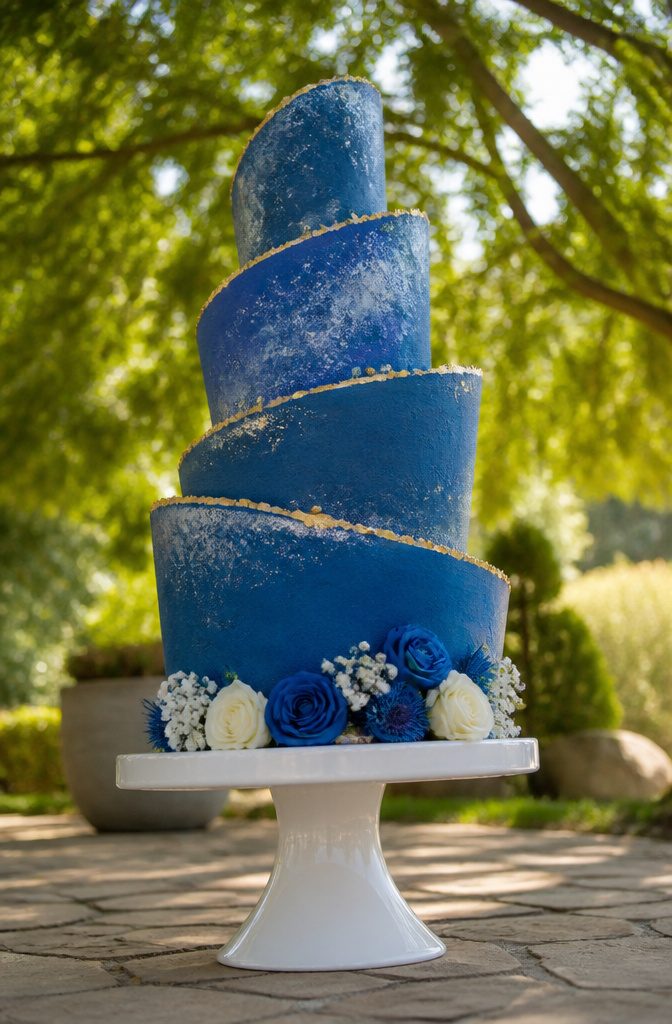
A topsy-turvy blue tier cake brings the Mad Hatter energy that still reads celebration rather than costume party.
The tilt comes from cutting each tier at an angle before stacking, so every tier needs its own cake board and hidden pillars drilled through at true vertical or the whole thing leans into disaster by hour two of the party.
I would not hand this to a baker who has never built internal structure before.
The pillars must sit plumb even though the cake above them sits crooked, which means measuring twice and accepting that the first attempt may need a redo.
Royal blue buttercream or fondant covers the seams, and a thin dusting of edible silver keeps it from looking like a graduation cake that took a wrong turn.
For an 18th birthday, this one wins on sheer theater. You will need time and hardware: cake boards, pillars, a center dowel, and the patience to level something that is intentionally unlevel.
If you have not stacked a straight tier cake yet, start there. This shape doubles the failure modes and halves the forgiveness.
10. Personalized Photo Cake

An edible printed image on an icing sheet is one of the most direct ways to make an 18th birthday cake feel personal.
The technology is straightforward enough that most grocery store bakeries can handle it, which matters when you need this done on a Wednesday with pickup Thursday after work.
Two printing methods dominate. Inkjet with edible ink on frosting sheets is the common option: food-grade cartridges deposit dye onto a thin, flexible icing layer that then melds onto buttercream or fondant.
Sublimation exists as an alternative, using heat to transfer dye into a specialty coating, though it is harder to find outside dedicated cake supply shops and the equipment costs more than a home baker typically justifies.
Your phone photo may print grainy blown up to cake size, and there is no fixing that in the bakery.
The original image resolution decides everything. A photo that looks sharp on a screen is often 72 DPI, which spreads into visible pixels across an 8-inch or 10-inch surface.
For clean results, ask whoever is printing for a test on a small sheet first, or source a higher-resolution version of the image if you are reprinting something old.
Buttercream accepts the icing sheet more forgivingly than fondant, since the sheet’s own slight texture blends in rather than sitting on top of a perfectly smooth surface.
11. Lilac Drip Cake with Roses

Lilac occupies the quiet middle ground between pink and purple, which makes it feel less predictable than either for an 18th birthday cake.
A drip in this tone reads soft and grown-up rather than childish, and it pairs naturally with buttercream roses in matching lilac or a slightly deeper violet for contrast.
The drip technique itself is forgiving. You pour thinned ganache or buttercream along the top edge and let it run where gravity takes it, so imperfections just add character.
Your base coat of frosting needs to be smooth and chilled firm before you start, or the drip will pick up crumbs and look muddy.
For the roses, buttercream keeps the whole cake food-safe and ready to slice without fuss.
Fresh flowers can work, but the stems need to be wrapped in floral tape and inserted into drinking straws or flower picks so no raw plant material touches the cake.
Most home bakers skip that step and pipe roses directly onto the tiers, which also means you control the exact shade.
Pipe them on a parchment square first, freeze until hard, then lift them onto the cake with a small offset spatula. You will avoid denting the drip or smudging the finish, and you can rearrange before anything sets.
12. Floral Garden Tier Cake

A Floral Garden Tier Cake stacks two or three tiers and buries them under roses, peonies, hydrangeas, and filler blossoms until the surface reads like an overgrown trellis.
The effect is showstopping, but the labor splits cleanly into two paths with very different clocks attached.
Fresh flowers run faster. You will need florist-grade blooms grown without pesticides, washed, and wired with food-safe picks before they touch the cake.
Most grocery-store bouquets carry spray residues, so a florist who supplies wedding cakes is the safer call. The arrangement itself takes a couple of hours, and the cake stays fresh for the day.
Sugar flowers flip the trade. Each petal gets cut, thinned, veined, dried, and assembled by hand; a full garden spread demands twenty to forty hours of bench time.
What you get in return is permanence. Kept dry and dust-free, those blooms become a keepsake that outlasts the party by years.
For an 18th birthday, fresh wins if the cake ships to a venue and the timeline is tight. Sugar wins if you are the one making it and want the work to mean something beyond the last slice.
I would choose fresh for a first attempt and reserve sugar for a baker who has already survived wedding season and wants the challenge.
13. Black and Gold Gamer Cake

A black and gold gamer cake ages the theme up without losing the reference.
Gold leaf or metallic buttercream replaces neon green and electric blue, and a simple controller silhouette in molded fondant reads as adult rather than adolescent. The palette shifts the whole idea from game room to evening event.
For the controller, edible printed wafer paper gives you crisp button detail without sculpting tiny fondant joysticks by hand.
If you prefer dimension, a single fondant cutout laid flat against the tier still reads clearly from across the room; that is usually the smarter call for a home kitchen.
Gold accents work best as stripes or a drip edge, not scattered stars or confetti shapes, which would slide back toward birthday-party territory.
What you spend in return is time. Metallic buttercream needs chilling between coats to keep the sheen, and wafer paper softens in humidity, so plan the assembly within a few hours of serving.
Skip character figures entirely. At 18, the silhouette says enough.
14. Pink and Gold Regal Cake

A soft pink buttercream sets the stage for this one, and the restraint is what makes it read as expensive.
One gilded crown topper, one monogram in edible gold, or one clean band of metallic leaf around the base: you pick the single regal element and leave it at that.
Scatter gold flakes across the whole surface and the eye has nowhere to land; the scattered-busy look undercuts the very sophistication you paid for.
The pink itself matters.
Go too bubblegum and the cake tips sweet-sixteen. A muted blush or dusty rose, something closer to the inside of a seashell, carries the crown without competing.
For the gold, edible luster dust mixed with lemon extract brushes onto fondant details cleanly, or you can buy a pre-made gumpaste crown and spray it with gold food color if you are not confident piping fine lines.
I think this option wins for anyone who wants the birthday to feel like an occasion without veering into costume. The single initial or crown does the formal work; the pink keeps it young enough for eighteen.
The trade-off is that it photographs best in soft light. Harsh flash flattens the metallic details into yellow glare, so plan the candle moment for a dimmer corner of the room.
15. Navy and Gold Modern Cake

Deep navy fondant reads more adult than royal blue for an 18th birthday cake, and the warmth of gold flatters it in a way silver never quite manages.
I keep the geometry tight: thin tape lines in real gold leaf or edible gold paint laid across clean negative space, never cluttered.
The modern look lives or dies on sharp edges and a perfectly smooth finish, which means the fondant goes on at room temperature over a chilled buttercream crumb coat, then sets hard before you touch it with any metallic detail.
A scraper held at 90 degrees while the fondant is still workable gives you those clean corners. Gold leaf on navy is forgiving in one way; the contrast hides a faint seam.
It is unforgiving in another: every fingerprint shows, so I work with a dry brush and tweezers, not fingertips. The result feels expensive without needing tiers or toppers, which matters when the birthday itself is the statement.
16. Royal Blue Drip Cake

A royal blue drip cake reads as formal without going fully traditional.
The ganache needs to hit a pourable consistency that ribbons rather than runs, and the only reliable way to judge that is to lift your spoon and let it drip down the side of the bowl first.
If it slides in thick, slow folds, it will set in controlled drips on the cake. Too thin, and you will have blue puddles at the base instead of defined trails.
Royal blue gel color is what gets you depth without the metallic or bitter edge that liquid dyes can leave. You will need more of it than you expect for a true royal shade rather than a pastel.
I build the color in the white chocolate ganache itself, then pour it over a white or pale blue base so the contrast reads cleanly rather than muddies into purple.
White buttercream underneath gives the sharpest result, but a sky-blue base softens the look for someone who wants the drama toned down.
Either way, the drip is the statement, and the 18 on top should be simple: molded chocolate or a gold acrylic topper, nothing competing for attention.
17. Pink Ribbon Vintage Cake

Pale pink ribbonwork reads as unmistakably celebratory without shouting. The vintage style borrows from 1980s and 1990s wedding cakes: soft folds, piped or fondant bows, and fabric-look draping that wraps the tiers like a dressmaker’s finished edge.
For an 18th birthday, the formality lands right. It marks the occasion as a threshold, not a kid’s party.
The ribbon itself can be real satin on a fondant base, removed in one strip before the cake is cut, or modeled in all-edible gumpaste if you prefer guests to eat every piece.
Real fabric gives a softer drape and truer sheen.
Gumpaste holds a crisper bow but dries hard enough to threaten a tooth. I would choose fabric for a cake that sits at room temperature for hours, since gumpaste softens in humidity.
Color is the control point. A pale pink this close to white risks looking like a bridal shower holdover.
Add one drop more gel than you think, or pair it with a second accent color, a muted sage or antique gold, to keep it firmly in birthday territory.
18. Chocolate Lovers Cake

An all-chocolate 18th birthday cake reads as deliberate luxury rather than safe default when you build it from more than one type of chocolate.
Dark layers, milk chocolate ganache, and white or ruby chocolate decorations give the monochrome palette actual depth; without that contrast, brown on brown flattens into mud.
I like a cocoa-dusted matte finish against glossy ganache drip and a few crisp chocolate shards for the same reason. The textures do the visual work so no other color has to.
Semi-sweet layers with milk chocolate buttercream stay crowd-friendly without cloying. Ruby chocolate, where you can find it, adds a subtle berry note that cuts through the density.
White chocolate works as a pale accent against dark tiers, though it needs a firmer ganache ratio or it will read as yellow under warm kitchen lights.
Skip the cocoa butter transfer sheets and molded truffle toppers unless you own the molds already; a bench scraper and a warm spatula give you the same polished look with what is already in your drawer.
19. Number 18 Chocolate Cake

A number-shaped 18th birthday cake in chocolate reads instantly from across a room, which matters when guests are snapping photos before the candles even go out.
The numerals need to stand at least 4 inches tall for that visibility, whether you cut them from a sheet cake base, mold them from tempered chocolate, or bake them as oversized crisp cookies and stand them upright.
Chocolate swirls and gold accents turn the dark surface into something celebratory rather than plain.
Candy pieces pressed into the finish add texture and give guests something to pick at before slicing, though I would keep the color palette tight; too many competing shades and the "1" and "8" start looking like a bakery clearance table.
The age itself becomes the centerpiece, which feels right for a milestone that only happens once.
20. Vintage Floral Buttercream Cake
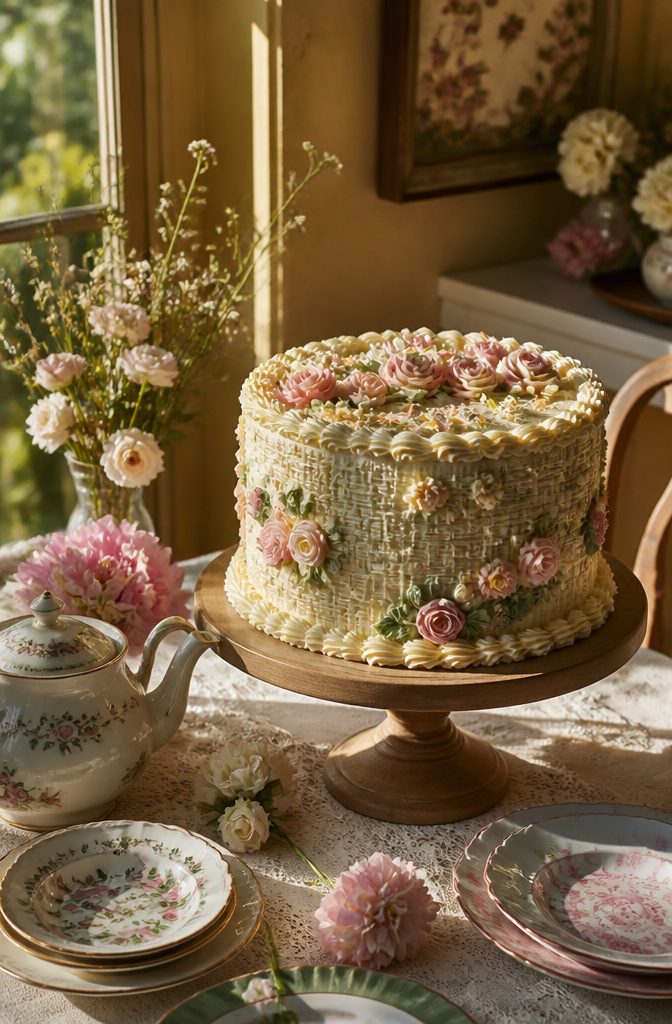
An all-buttercream finish keeps the flavor where it belongs and spares your guests from peeling off a sheet of fondant at the table.
The vintage look comes from piping technique, not from settling on a particular color palette; basketweave, Lambeth-style over-piping, and ribbon roses all read as retro, and any of them works as well in sage or dusty blue as it does in the classic blush and ivory.
No fondant means easier slicing and a cake people actually want to eat.
The texture of buttercream against the cake is the point, and these old-school textures hold up for hours at room temperature without cracking the way fondant can in humid kitchens.
Basketweave is the most forgiving place to start: the pattern hides small inconsistencies, and a turntable plus a single basketweave tip is the only gear you need.
Lambeth over-piping builds dimensional borders from repeated thin lines, which looks elaborate but moves quickly once you establish the rhythm.
Ribbon roses pipe flat onto the cake sides or cascade down a tier; they use the same petal motion as buttercream roses, just laid sideways.
What you spend in return is time. These techniques reward a steady hand and a cool kitchen, and rushing the buttercream to spreading temperature leaves soft ridges that won’t hold their shape.
Start the cake a day ahead, chill the layers firm, and pipe in short sessions so your hand stays relaxed.
Frequently Asked Questions
What are some unique 18th birthday cake ideas?
Each design targets a different personality, whether romantic, modern, nostalgic, or hobby-driven, so you can match the cake to the birthday person rather than defaulting to generic frosting.
How do I choose the perfect birthday cake?
Build the design around the birthday person’s actual interests, not just age-appropriate colors. A cake that references something real about them beats a cake that merely looks nice.
What is the typical lead time for ordering a custom cake?
Plan on 2 to 3 weeks for a custom order, according to industry standard.
What is traditionally given on an 18th birthday?
The milestone itself is the tradition; the cake’s job is to signal that crossing point visually.
What color symbolizes an 18th birthday?
Black paired with gold or silver reads as instant luxury; deep navy and gold feel modern and adult; cherry red and vintage piping evoke occasion and history. The common thread is saturation and restraint, not a specific hue.
What do you write on an 18th birthday cake?
Keep the text minimal and let the design carry the weight. On a drip cake or tiered design, the number itself is enough; competing words dilute the visual impact.