The right funny cake decorating idea depends on whether the joke needs to survive a crowded party or reward close inspection.
A gravestone cake lands from across the room because the shape reads instantly as memorial, while a toilet paper roll demands that guests actually count the fondant sheets to get the punchline.
That difference, between visual gag and interactive joke, decides which design fits your crowd before you even pick up the piping bag.
Not every idea survives every kitchen. The Netflix "Are you still watching?" screen needs a bench scraper held at 90 degrees while the buttercream crusts, or the flat finish fails and the electronics illusion collapses into textured cake.
The upside-down spill cake needs a dowel dead center or the whole assembly torques sideways when moved. Skill level and patience limit the list more than imagination does.
A single detail anchors each option to reality: forty buttercream sheets spiraling down a toilet paper roll, the 15-second drip test for green slimy monster icing, eight or nine fondant nubs aligned in a proper grid atop a Lego brick.
These constraints are what separate a cake that makes guests laugh from one that makes them politely nod.
1. Over the Hill Gravestone

The gravestone shape carries the joke before anyone reads a word of icing. A tall slab with a rounded top reads instantly as a memorial, so the "RIP Youth" inscription lands as punchline rather than puzzle.
Fondant flowers tucked into the corners soften the morbid shape just enough to keep it party-appropriate; without them, the cake risks reading as genuinely gloomy rather than playful.
Gray buttercream or marbled fondant gives the stone its weathered look, and the lettering works best in a simple serif piped in black so it mimics actual carved text.
The humor depends on the crowd: at a 40th or 50th birthday, everyone in the room is in on the same joke about aging. At a 30th, it can feel forced; at a 60th, the gag may cut too close.
I prefer this design for the visual economy. Unlike cakes that need explaining, the gravestone communicates its meaning in a single glance, which matters when guests are arriving with drinks in hand and only half-looking at the dessert table.
2. Toilet Paper Roll

A toilet paper roll cake works because the joke lands the instant guests recognize the shape, then keeps delivering as they count the sheets.
Each sheet represents another year of age, so a forty-year-old gets forty fondant or buttercream layers spiraling down the side. That counting turns the decoration into something interactive: guests point, tally, and trade guesses before the candles even come out.
The everyday object carries the humor. No one expects a birthday centerpiece built from bathroom imagery, which is exactly why it gets a laugh.
Gray fondant handles the cardboard tube, white buttercream or thin-cut fondant forms the sheets, and a little careful spacing shows the spiral unrolling.
Keep the sheet count accurate to the age, because a guest who bothers to count and finds the joke shortchanges the number feels the fun deflate.
This idea sits in the same territory as the prescription bottle "anti-aging pills" cake, but the toilet paper version wins for parties where guests mingle before the cake is cut.
The counting gives them something to do with the decoration, not just look at it.
3. Netflix Binge-Watching
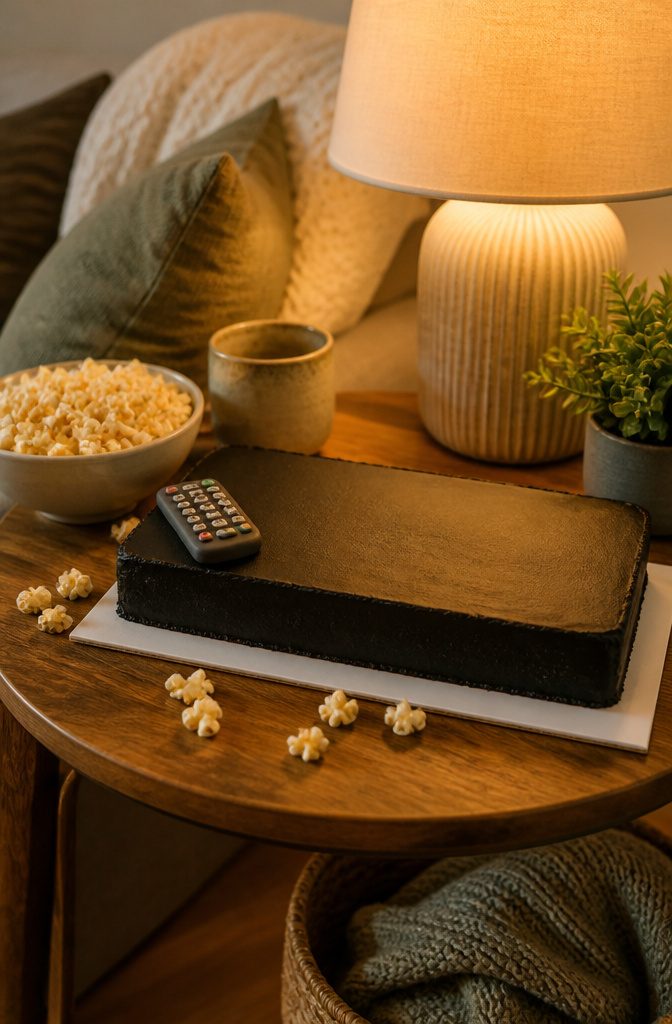
The Netflix cake works because the message lands before the decoration even registers.
A flat rectangle, frosted in that dark charcoal almost-black that passes for a TV screen, carries the words "Are you still watching?" in thin white icing along the center.
The font matters: rounded, slightly too large, spaced the way Netflix spaces it. Get that wrong and the joke dies.
I have seen this done with a small fondant remote control placed at the base, buttons and all, though a cleanly piped remote in buttercream holds up better on a warm counter.
The receiver recognizes the prompt immediately. Millennials who burned through entire series in single weekends understand the guilt and the laughter in equal measure.
The screen surface is the only part that needs real precision.
A bench scraper, held at 90 degrees while the buttercream crusts, gives the flat finish that sells the illusion. Any texture reads as cake, not electronics, and the humor needs that split-second of recognition to work.
Keep the sides simple. The joke is on top, not wrapped around.
4. Diet Starts Tomorrow

The donut shapes on this cake need to read as obviously fondant, obviously fake, or the joke collapses into something genuinely depressing.
I build each one from a thick disk of pale pink or yellow fondant, then add a second, smaller disk on top for the raised look of a yeast donut, with a clean circle punched through the center.
No shading, no glaze drip, no attempt at realism. A real sprinkle mix pressed into the surface is fine because it keeps the color loud and the texture flat.
The humor works on the gap between promise and reality. A cake already breaks most diets, so covering it in cartoon desserts mocks the "tomorrow" we all claim is coming.
The fondant donuts sit on a base of smooth white buttercream, spaced like they just rolled off a bakery tray that never existed.
I keep them half an inch thick, no thinner, so they cast a small shadow and read as objects placed on top rather than decoration painted on.
Cleanup is straightforward: the donuts lift off before slicing, and the buttercream underneath is untouched.
5. Angry Cat
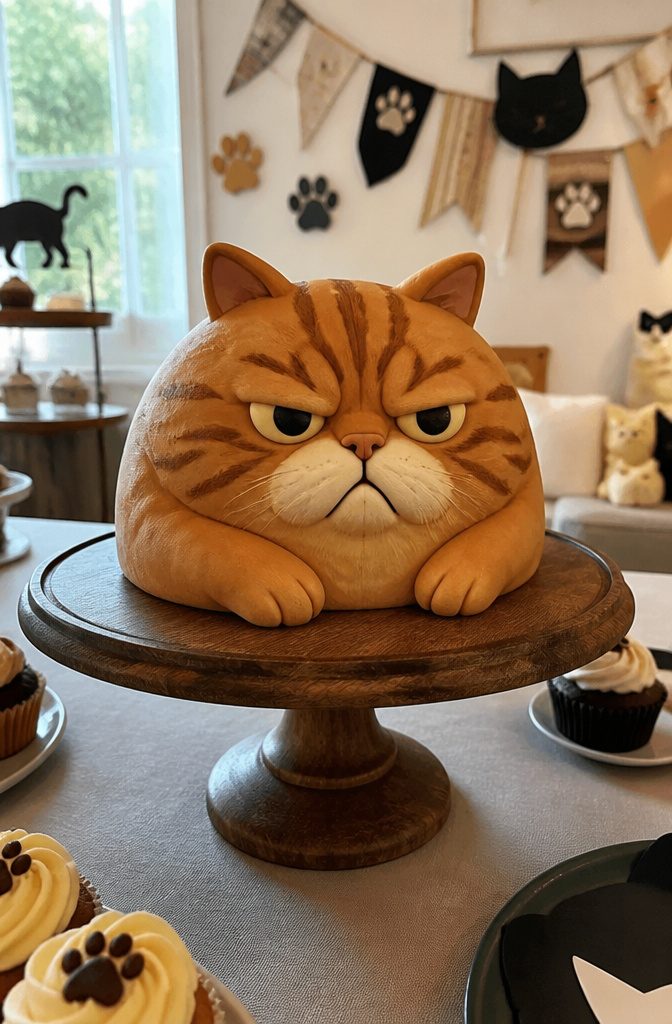
The angry cat cake works because the internet has trained everyone to read a very specific face: half-lidded eyes, ears flattened slightly back, and a mouth set in a hard downward curve.
Get any of those wrong and you have a generic cat. Get them right and the room recognizes the mood instantly.
I build the head from a single dome of cake, then cover it in smooth fondant tinted the muted orange-brown of a tabby.
The expression lives in three places. The eyes sit at a slight tilt, with heavy upper lids that drop to about two-thirds of the iris; I paint the pupils as narrow vertical slits, almost touching the lower lid.
The ears need to angle backward, not perk forward like a happy cat, with the inner pink kept minimal and shadowed.
The mouth is a simple inverted curve, but I add two small bumps at the corners, the hint of jowls that suggest the cat is holding something back.
Whiskers should droop rather than stand alert.
I pipe them in black royal icing and aim them downward at 45 degrees. One whisker broken or crooked improves the joke; perfect symmetry reads as effort, and this face is all about unwillingness to try.
6. Spaghetti and Meatballs

A plate of spaghetti and meatballs stops guests cold when they realize the fork is stuck in cake. The humor lives in that double take: the brain registers dinner, then catches the fondant giving itself away.
The sauce color sells the illusion more than the noodles do. A deep, slightly orange-red buttercream reads instantly as marinara in a way that paler shades never manage, and a matte finish beats glossy for looking like actual cooked tomato.
The plate itself needs a lip, not a flat slab. A shallow round cake with a raised edge tricks the eye into seeing ceramic rather than dessert, and the curve casts a small shadow that sells the depth.
For noodles, pale yellow fondant extruded through a garlic press or clay gun gives the right uneven thickness; hand-rolled strips look too uniform and too neat.
Meatballs are cake balls, of course, rolled small and left deliberately imperfect so they sink slightly into the "sauce."
A dusting of grated white chocolate stands in for Parmesan. The whole thing works because it borrows the mess of real spaghetti, stray sauce smears and all, rather than aiming for tidy perfection that would read as cake immediately.
7. 3D Taco

A 3D taco cake lives or dies on the fold. Get the shell geometry wrong and your guests will ask why you brought a burrito to the party.
Build the cake at an angle, not a roll: two wedges of cake meet at a sharp central seam so the shell opens upward and the fillings sit on display.
That open top is what sells the joke.
Fondant lettuce, cheese, and tomatoes need to tumble out visibly or the shape reads as generic wrapped food. I like to let the "toppings" spill slightly over the front edge, which also hides any seam work at the fold.
A face on the side helps, though I would keep the expression simple; too much detail competes with the silhouette that makes this recognizable from across the room.
Cinco de Mayo and birthday parties both suit this design, but the assembly is weekday-realistic only if you build the shell from a half-sphere carved in two rather than sculpting freehand.
The curve is already there, the bake is even, and you save an hour of crumb-coating frustration.
8. Leaning Ice Cream Stack
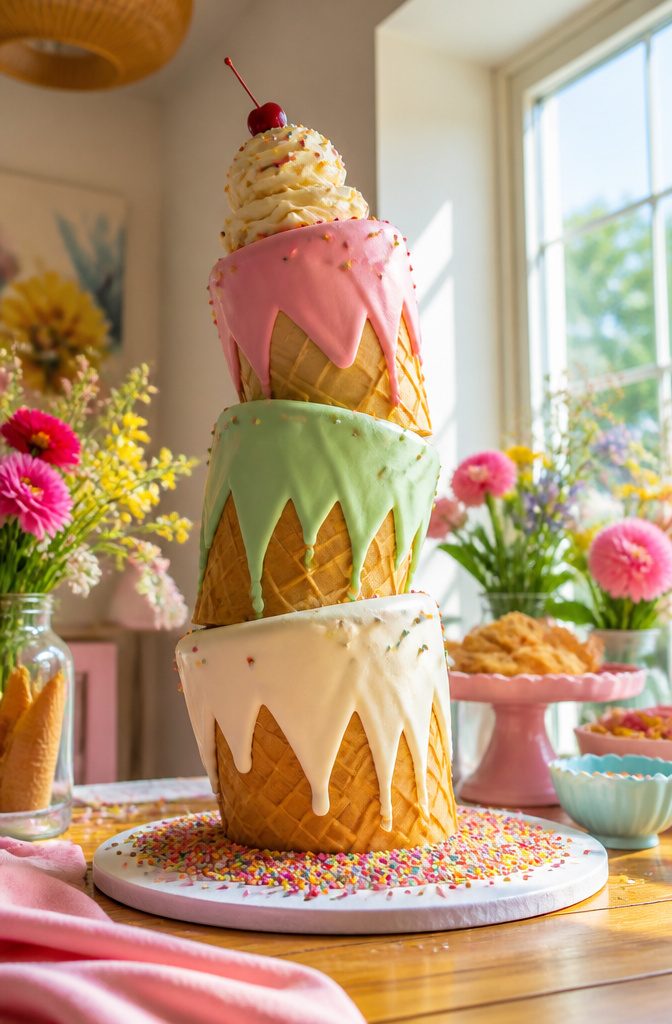
The leaning ice cream stack works because the tilt triggers a reflexive wince before the laugh of relief.
I build the angle by stacking three graduated tiers off-center on a central food-safe dowel, then anchoring the dowel into a weighted cake board so the cantilever reads as precarious but resists any nudge.
The drip is soft-peak buttercream thinned just enough to flow in controlled ribbons down the tilted face, plus a scoop of buttercream "ice cream" at the top with its own slow drip hardened in a cool kitchen.
I run the drip from the highest point downward so gravity cooperates with the illusion instead of fighting it.
The real engineering sits inside: a sharpened dowel through all tiers and into the base, plus a smaller secondary skewer bracing the lean at the back where guests never look.
Without that brace, the buttercream weight pulls the top tier sideways over an afternoon. With it, the cake stays frozen in its moment of near-collapse for hours.
For home kitchens, this means no special armature, just patience in assembly. Offset the bottom tier an inch from center, build upward with the dowel as your spine, and the cake does the comedy for you.
9. Rubik’s Cube
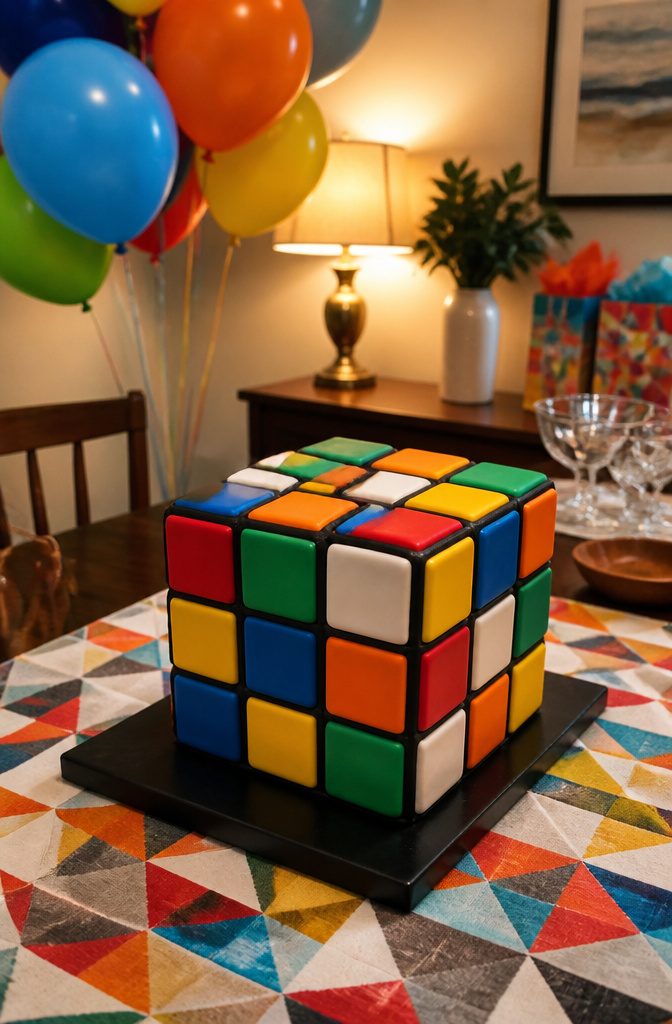
A Rubik’s Cube cake lands its joke through recognition.
Anyone who grew up twisting the real puzzle in the eighties or watched their kids fight over one sees those bright fondant squares and the nostalgia hits before the humor even registers.
The grid needs to stay slightly unsolved, because a perfectly arranged color pattern reads as just another box.
Offset two or three squares, leave one face half-scrambled, and the brain snaps to the joke: this is the puzzle that frustrated you, now served on a cake stand.
The celebrant’s reaction splits predictably. Some guests laugh at the visual pun; others feel that old twinge of irritation, the memory of a cube they never managed to finish.
Both responses work for a funny cake. The fondant work is straightforward grid cutting, no specialty tools beyond a ruler and a sharp knife, though getting the square edges clean takes patience.
Bright primary colors are the right choice here, not pastels or trendy shades. The original toy used a specific palette, and deviating from it weakens the recognition that carries the whole idea.
10. Melting Ice Cream Cone

The melting ice cream cone cake works because it celebrates the exact moment parents normally try to prevent: dessert collapsing into a sticky puddle. The humor lands in that permission to make a mess.
The drip icing has to read as liquid while behaving like a solid.
I set the cone at a slight tilt, then pipe ganache thickened just past flowing so it holds a rounded curtain down the side rather than sheeting straight off.
A cream cheese base helps the frosting keep its structure during transport, especially in warm conditions where true buttercream would soften and lose its shape.
Color matters for the read. I tint the scoop a saturated strawberry or mint, then let the "melt" run vanilla or chocolate so the contrast reads instantly as ice cream separating from cone.
Sprinkles at the drip’s edge sell the accident, like they tumbled from the scoop on its way down.
Stacking layers in alternating flavors adds a surprise when the cake is cut, though any single flavor works if the visual gag is your priority.
The whole thing takes about 1 hour 20 minutes from prep through decoration, and the effect holds for the length of a birthday party before anyone insists on slicing it.
11. Dinosaur Landscape

A dinosaur landscape cake lands its joke in the terrain, not the toys.
I have seen this done with green buttercream dragged into peaks for grass, crushed chocolate cookies pressed into frosting for dirt, and a few chocolate rocks scattered like boulders.
The dinosaurs, whether fondant or clean toy figures, are almost incidental; swap them for farm animals and the cake still reads as landscape.
What makes it funny is the scale mismatch between a tiny plastic T-Rex and a mound of cake the size of a volcano.
For the prehistoric look, use green and brown food coloring in the batter itself, then green icing on top.
Chocolate rocks add the texture that flat frosting cannot manage alone. If you use mini dinosaur figurines, nestle a couple into the frosting so they look half-buried in the scene rather than posed on top.
One source notes you can even hide a figure inside a layer for a surprise when the cake is cut, though I would warn guests first.
Edible glitter gets mentioned for a "Jurassic" shimmer, but I would skip it.
The humor here is low-tech and slightly retro; glitter feels like it is trying too hard. A clean toy dinosaur, well-washed, works as well as an edible one and saves you hours of fondant sculpting.
12. Cookie Monster

A Cookie Monster cake works because the mess is the joke.
Pile the face with blue buttercream fur, set two oversized fondant eyes wide apart, and leave the mouth gaping open so real chocolate chip cookies tumble out onto the plate and across the table.
The more cookies scattered, the better; guests should spot this from across the room and laugh before they even cut a slice.
Real cookies win over fondant ones every time.
Fondant can shape a perfect miniature chip, but it reads as decoration. A crumbling, actual cookie grounding into the frosting gives you texture contrast and makes the chaos believable.
Kids grab them, adults sneak them, and the cake keeps looking wilder as the party goes on. That edible disorder is what separates a funny cake from a cute one.
13. Slimy Monster

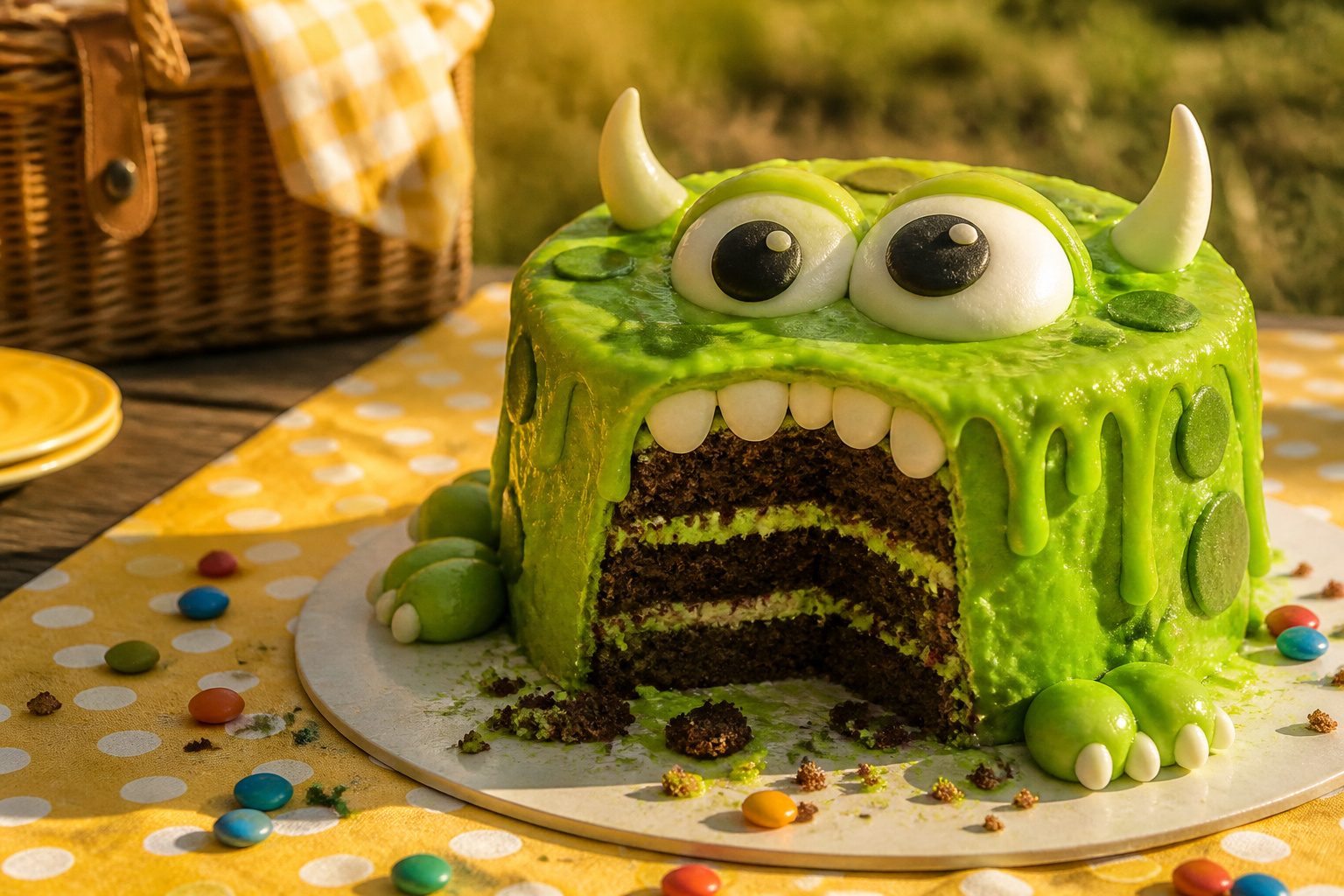
Bright green buttercream with the right drip consistency turns a plain cake into something that makes kids gasp and adults laugh before they even pick up a knife.
The icing needs to be thin enough to run down the sides in slow, deliberate trails, but thick enough that it sets into glossy ridges rather than a puddle at the base.
I find a 15-second drip test tells you what you need to know: lift your spoon, and the ribbon that falls back into the bowl should disappear in about that window.
Googly candy eyes are what sell the gag. Two oversized ones, placed slightly off-center and at different heights, give the slime a personality; three or four smaller eyes clustered near the top edge read as a surprised creature peeking out.
The eyes should sit on the icing while it is still tacky, or they will slide with the drip and look like an accident rather than a character.
This one works because the gross-out stays theoretical.
The green is too vivid to be mold, the eyes too cartoonish to be unsettling. It is a cake that dares you to flinch, then makes you grin.
14. Burger and Fries

The cheeseburger cake works because the details are specific enough to read as food rather than abstract shapes.
A round yellow cake with a red stripe looks like a target; add a textured fondant bun with sesame seeds pressed in and a ruffled green edge for lettuce, and the illusion locks in.
The seeds can be tiny fondant balls or piped royal icing, but they need to be irregular, not uniform, or the brain registers pattern instead of bread.
The fries matter just as much. A pile of yellow fondant sticks alone looks like a failed Jenga set.
Tuck them into a red-and-yellow folded paper carton, the kind every fast-food chain uses, and the context completes the joke. The carton is simple origami: a rectangle of food-safe paper, folded into a trapezoid with a tab tucked inside.
Without it, the fries read as an afterthought. With it, the whole setup looks like someone dropped their lunch on the dessert table.
Keep the bun slightly taller than it is wide.
A squat sphere reads as meatball, not burger. The patty layer should sit lower, with a subtle darker edge where the fondant meets the board, mimicking the shadow of a real grill-marked burger.
15. Pizza Slice
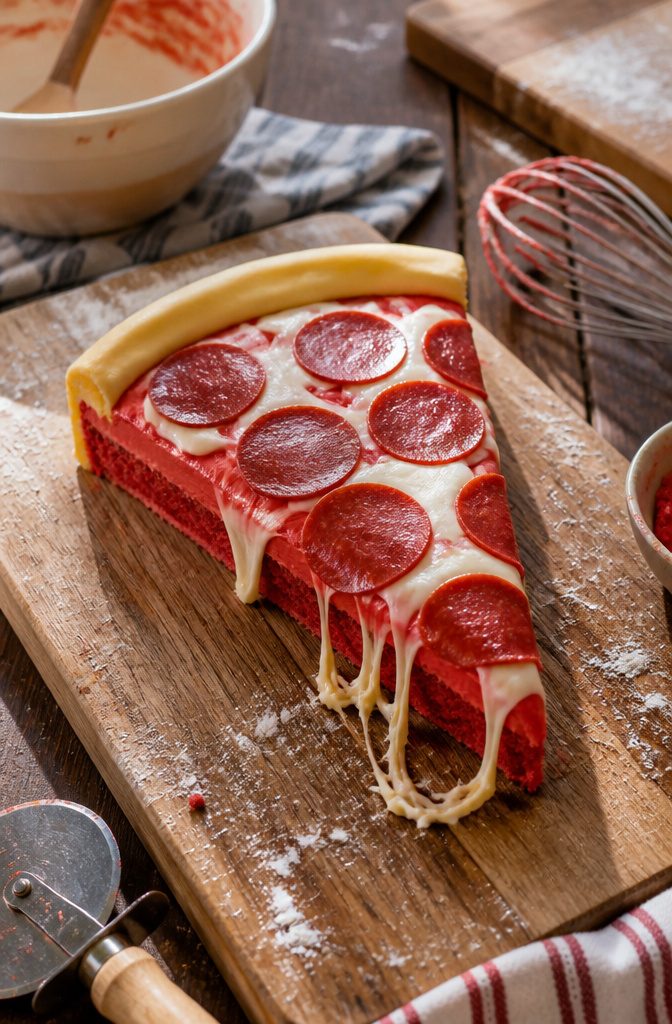
A wedge-shaped cake frosted in tomato-red buttercream with a pale yellow fondant crust bakes up fast in a standard half-sheet pan.
Trim the cooled cake into a long triangle with a curved outer edge, then coat the sides in the red "sauce" before adding the top layer of yellow.
The cheese pull effect comes from a strip of pulled sugar or softened white candy melts draped between the tip of the slice and the serving board.
You want it thin enough to read as translucent, not thick enough to look like a rope.
For the pepperoni, roll commercial fondant to about 1/8 inch.
Any thinner and the rounds warp when you lift them; any thicker and the disks sit on the surface like poker chips instead of sinking slightly into the "cheese" the way real pepperoni does.
A small round cutter gives you the size, and a dab of water on the back adheres each piece without sliding.
I finish the look with a sprinkle of grated white chocolate for Parmesan and a few basil leaves cut from green fondant. The whole thing takes about two hours from baked cake to photographable, and the reactions are reliably loud.
16. Waffle Stack

The grid pattern is what sells the illusion. Without those pressed squares, you are looking at a tall layer cake with syrup on it, which is not the same thing at all.
I have seen this done two ways, and one is clearly easier on a soft buttercream surface. A clean waffle iron pressed gently into the chilled frosting leaves a deep impression in seconds, but timing matters.
Chill the stacked cake until the buttercream crusts over, about 20 minutes in the fridge, or the iron will smudge rather than imprint.
The alternative is piping the grid with a small round tip, which takes longer but gives you cleaner control over line weight. Pipe vertical lines first, let them crust, then pipe horizontal lines across.
The syrup drip is straightforward: thinned caramel or butterscotch poured from a spoon down the top edge, allowed to set until tacky. A single fondant butter pat, pale yellow and slightly irregular, sits dead center on the highest "waffle."
The whole stack reads as breakfast immediately, which is the joke. The only risk is height.
Above three layers, the imprinting gets awkward; the cake wants to shift under even light pressure. Two layers, split and filled, gives you four visible "waffles" and a stable surface to work on.
17. Lego Block Stack
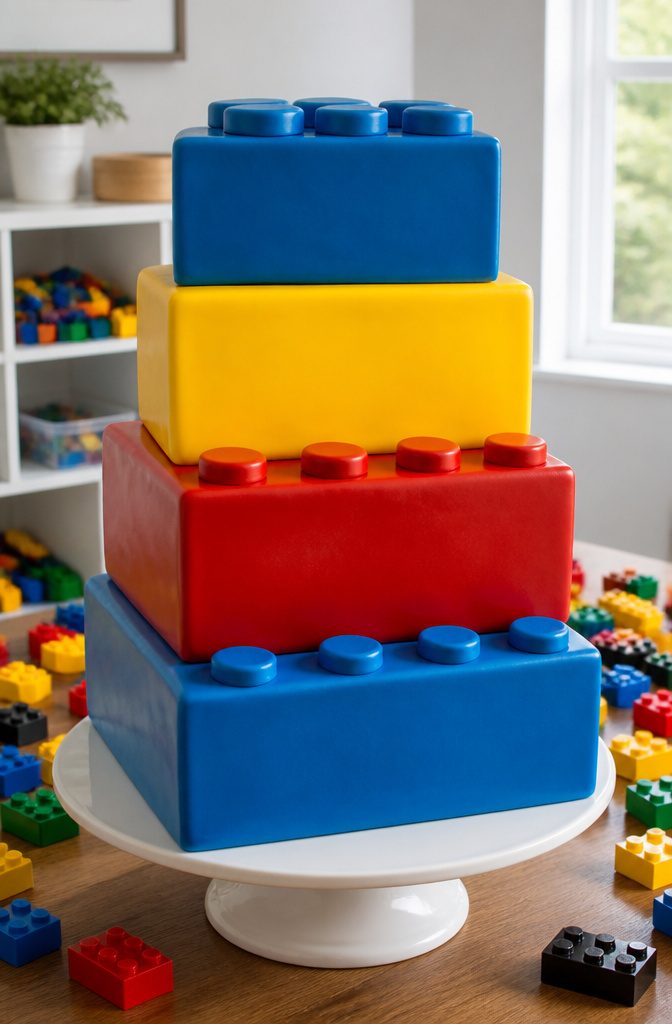
A Lego cake lives or dies on those tiny connecting nubs spaced across the top. Without them, you have a plain rectangle in primary colors, and the joke is lost.
I roll bright fondant to about an eighth-inch thickness and cut clean rectangles for the brick faces.
Sharp edges matter more than architectural ambition here; one flat tier in candy red, one in cobalt blue, and a smaller yellow accent brick on top reads instantly as Lego to anyone who has stepped on one barefoot.
The nubs are fondant circles roughly the diameter of a quarter, attached with a dab of water and aligned in the grid pattern real bricks use. Eight or nine per standard brick face is enough.
Precision beats scale. A three-tier masterpiece with wobbly nubs looks like a toy factory accident, while a single six-inch square with perfect cylinders on top wins the laugh.
Cleanup is minimal since fondant scraps knead back together, though I keep a bowl of cornstarch nearby for sticky fingers.
18. Upside-Down Spill
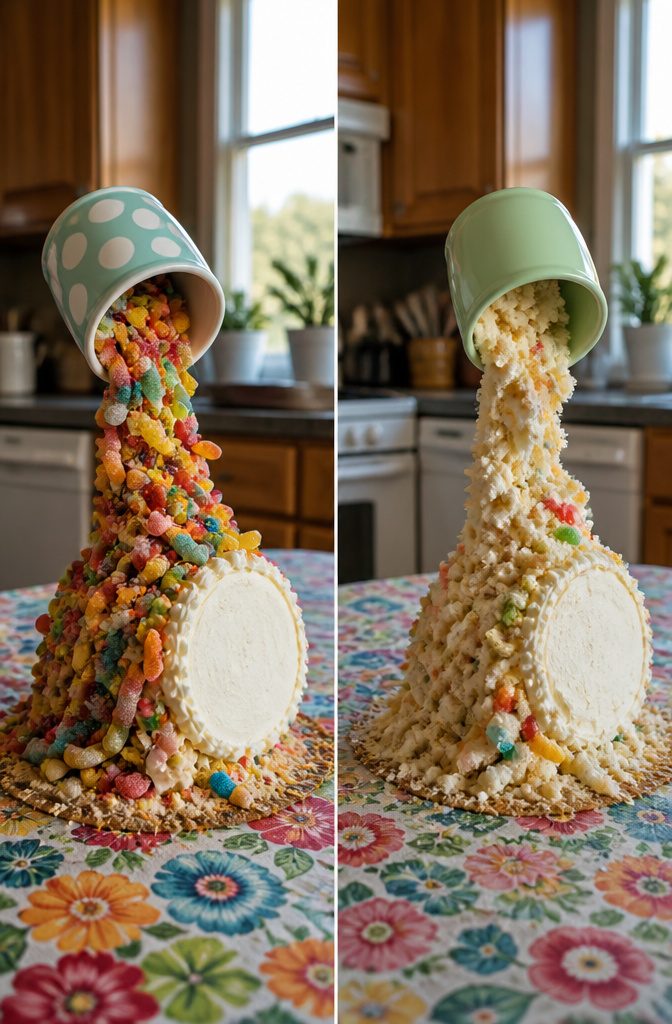
The upside-down spill cake lives on visual confusion. You set a real cake layer flat, then attach a second layer to its side so the decorated "top" faces outward like a wall.
What reads as the cake’s upper surface is actually frosting-covered cardboard, supported by a hidden dowel or thick straw running from the false top down through the real cake into the board below.
The gap between the two layers becomes your spill zone.
Soft buttercream fruits, gummy candies, or poured ganache drip from that exposed interior edge, and the eye completes the joke: the cake hit the floor and everything flew out. A dusting of crumbs around the baseboard sells the landing.
For stability, the false top needs real weight or it spins on that single dowel.
A thin layer of actual cake on the cardboard, trimmed flush, gives the knife something to meet when someone eventually cuts in. The dowel must sit dead center in the real cake or the whole assembly torques sideways when moved.
Cleanup is standard; it is all in the assembly order. Build it on-site if you can, or transport it with the spill elements added after arrival.
19. Controlled Mess

A controlled mess cake gets its humor from looking like it was abandoned mid-decorating, but make that chaos readable rather than merely sloppy.
I scatter sprinkles and candies across the surface with no apparent order, yet I place each cluster where the eye naturally lands: heavier at the bottom edge, lighter toward the top, with one or two larger pieces anchoring the center.
Drips of colored icing run down the sides, but I control their paths by piping the starting point and letting gravity do the rest, so they read as deliberate drips rather than accidental smears.
The rebellion here is against the neat frosted cake your guests expect, not against structure itself. I use at least three distinct textures (smooth drip, crunchy sprinkle, chewy candy) so the randomness registers as designed sensory contrast.
Without that variety, the cake just looks unfinished. For kids’ celebrations especially, this approach invites fingers into the decoration before the knife even touches it, which is half the point.
20. Hanging Sloth
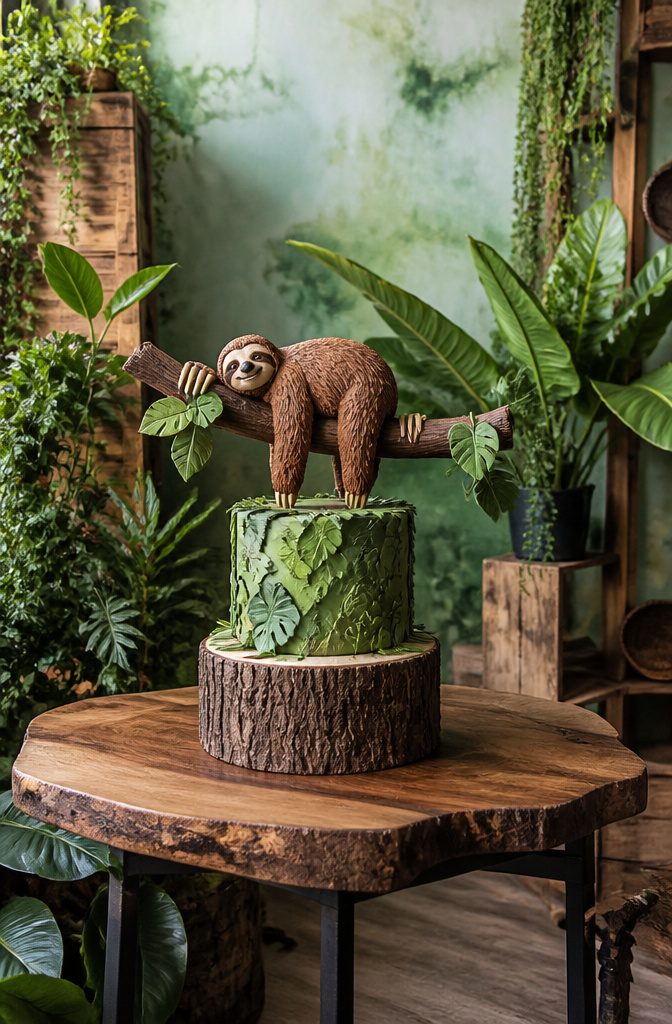
A sloth only reads as funny when it is actually hanging. The posture is the whole joke; stand the same shape upright and you have a brown animal cake that needs explaining.
The branch solves two problems at once. It is the visual anchor that tells everyone this is a sloth, and it is the structural support that lets the body drape at that characteristic angle without collapsing into buttercream.
One source builds the figure from brown fondant with chocolate ganache dragged through for fur texture, and the droop of the limbs over the branch is what sells the expression.
Edible fondant leaves finish the jungle setting, but the face does the work: wide-set eyes placed slightly too low give the slow, innocent stare that makes guests laugh before they cut.
The branch itself can be a solid fondant log or a real wooden dowel wrapped in food-safe material, depending on whether anyone eats the support.
Either way, the angle of the hang matters more than the detail of the fur; a 45-degree drape reads as lazy, while a straight 90 looks like a mistake.
Frequently Asked Questions
What makes a birthday cake idea actually funny?
A funny cake needs three things: a joke people already get, a design that reads instantly, and enough skill that the decoration does not need explaining.
The gravestone cake works because the shape carries the joke before anyone reads the icing; the Netflix cake fails if the font is wrong, because guests spend time puzzling instead of laughing.
How do I create a funny cake design?
Pick a recognizable object or phrase, then execute the details precisely enough that the brain registers the joke in under a second.
Color choice matters: the spaghetti sauce needs to be deep orange-red, not pale, and the Rubik’s Cube needs the original primary palette, not pastels.
The waffle cake requires a grid pattern, pressed into chilled buttercream with a clean iron or piped with a small round tip; without those squares, it is just a layer cake with syrup.
What are some funny cake decorating ideas?
Each uses a different hook: age jokes, food illusions, nostalgia, or visual chaos.